Vol. 3 No. 3 (2021): Oriental studies
Articles
The re-creation of conceptual metaphors in literary translation
This article is devoted to the study of the specific peculiarities of the French translation of conceptual metaphors in the Uzbek language on the basis of French translations of the works of E. A’zam. In order to reveal the peculiarities of the French translation of conceptual metaphors in the Uzbek language, three samples of E.A’zam's works and their translations by Sh.Minovarov were investigated. The analyzed metaphors were selected according to their originality, expression in translation, and level of influence on the content of the text. The classifications included to the content of orientational, structural, and ontological metaphors were expanded based on sources related to the semantic types of metaphors.
Some aspects of the Movarounnahr school of Sufism (as an example of Hakimiya and Khojagon-Naqshbandiya relations)
This article is devoted to the school of mysticism, which is an integral part of Islam in our country, and its peculiarities. In the context of today's scientific achievements, Movarounnahr is not mentioned among the mystical schools of the Islamic world, and there is a tradition of adding it to the Khurasan school. The school of the mysticism of Movarounnahr is famous mainly in the framework of the activities of Abduhaliq Gijduvani, the seven-pir chain, and Bahauddin Naqshband. However, as one of the first beginners in this field, Muhammad Hakim Termizi's factor is very important, and the combination of all of them plays a special role in the establishment of this direction as a school with its own characteristics. However, as one of the first beginners in this field, Muhammad Hakim Termizi's factor is very important, and the combination of all of them plays a special role in the establishment of this direction as a school with its own characteristics. This commonality has a sharp difference from other Islamic schools of the world. These differences and peculiarities require the study of the Movarounnahr's way of suluk as a "school", which still needs to be sufficiently studied in our country and around the world. It can be said that the distinctive features of the Movarounnahr school of Sufism reached its peak in practice through the activities of Abduhaliq Gijduvani and Bahauddin Naqshband after Muhammad Hakim Termizi sufficiently theoretically perfected it. In its time, this school demonstrated movements of reformism throughout the Islamic world that reflected the true purpose of religion. In particular, Gijduvani and Bahauddin Naqshband appears as a person who firstly practices backdoor dhikr and strengthened this practice and strengthened the socialization of mysticism on the basis of personal maturity through factors such as conversation and professional necessity Both men returned to the realm of mysticism the principle that all Muslims should strive for science, and by developing a system of "rashha" for "saliks", defined a high ideological framework, a disciplined practice - a clearly defined scope of action. Most importantly, all of these rules they introduced were based on the theory of the school of “hakimiya” that was recognized as a separate school in Movarounnahr in the X-XI centuries and founded by Muhammad Hakim Termizi. In particular, rashhas, professions, the primacy of science, and many other aspects were the hallmarks of this school.
Nietzsche and oriental philosophy
The reading of the works of the great German philosopher, famous writer and poet Fridriech Nietzschе (1844-1900) shows that his wise Eastern philosophical and artistic thinking was sufficiently enjoyed. In this article, The views of Nietzsche are the philosophical views of the East – the works of Zarathustra (Zardusht) “The Avesto” and works of Mavlana Jalal ad-din Rumi “Masnaviyi ma`navi” comparatively analyzed and researched.
Modern approaches to the study of modern international relations
The Cold War was not only traditional in international relations next phase of the struggle for world domination, but also an ideological war aimed to impose on the opposing powers a certain value system, social structure, political regime, etc. As a result the ideological conflict of the opposing powers became an important component of the Cold War. With the end of the Cold War the problems of «end of history» and the “end of ideologies” were actualized on the West. It became about an axiom that the world politics lost its ideological dimension. In fact, however, ideological component is deeply integrated into the emerging «new» world order. Even the dominance of Western countries in the emerging system of international relations was legitimated by the postulates of neo-liberalism. The coming to power in the USA of president D. Trump and changes in American foreign policy stress a deep transformation in the modern system of international 51 relations. Unconditional dominance of the liberal paradigm in global scale is gradually coming to an end. This process is accelerated due to the completion of the «unipolar moment» in world politics and process of step by step formation of a polycentric world order. The world is entering to a turbulent era. And one of its main features will probably be decline of ideology influence and the strengthening of political realism as an intellectual dominant in making decisions in dynamic and unclear international environment.
Theory and problems of democratic development in egypt and the middle east
Over the past 30 years, multi-party regimes have replaced single-party regimes in Arab countries. This process began in Egypt in 1976 with the division of the Arab Socialist Union into three groups. Later, in the late 1990s, Egypt established an electoral system that served the interests of the ruling party’s candidate under the provisions of the election law. This was since the powers of the head of state were constantly amending the constitution. Although Egypt is officially a republic, it can be considered a modern version of a parliamentary monarchy. Because the unlimited power of a political leader combines the functions of a party leader and a head of state in the person of one person. As Western democratization processes take place, tensions between moderate and radical forces and movements in the Arab world will increase. In general, the processes of developing a democratic and civil society in Egypt are unique, which is very different from the western understanding of these problems. At present, the Egyptian leadership faces a major problem of how to achieve political and social modernization in society.
Countries of the Middle East: social and political changes in recent decades
The given article covers the detailed information about the civil revolt which bears the name The Arab Spring, that took place in the Middle East and arabic countries of North Africa. It gives the answer to such questions as how the Arab Spring started, the outcomes of the revolt in the states which overcame it, and whether the people's lives have been improved after it or not.
Theoretical aspects of researching the history of modern diplomacy of Uzbekistan
The article notes that although representatives of the social and humanitarian sciences have not yet sufficiently studied the processes of formation and development of diplomacy of the Central Asian states and territories, subordinate to them, as well as the history of the development of the Uzbek diplomacy, a comprehensive study of various periods in the history of the problem and issues of international cooperation mainly began in the years independence. The author on the basis of the problem-chronological method conditionally subdivides the conducted research into several directions.
Analysis of some data in "Matlai Sa'dayn wa Majmai Bahrain"
“Matlai sadain wa majmai Bahrain” of Abdurazzak Samarkandi is the main source for studying the history of the Timurid period. From the source, we can obtain valuable information about socio-political events, diplomatic relations, culture and education, construction and improvement. The article analyzes the information presented in the source in the field of architecture and landscaping. The Temurid period is notable for large-scale creative and landscaping works. Is there such information in “Matlai sadain”? What architectural monuments can We get information about? The article deals with similar issues. After the death of Amir Temur, the struggle for the throne reached a highest point, and many devastations occurred. According to sources, during this period, construction work was mainly focused on defense facilities. After Shahrukh Mirza consolidated Saltanat in his hands, the construction work shifted mainly to the enlightenment buildings. During this period, many mosques, mausoleums, madrasas, and gardens were built. Along with the construction of architectural structures, much attention is paid to the improvement of cities. In particular, agriculture was developed in Merv and Balkh. The book contains a lot of information about the buildings built and sponsored by Shahrukh Mirza and his sons. There is also information about the construction work carried out by the Timurid ladies. In addition to the activities of the Timurids, many emirs built mosques and madrasas. This can also be found in the source. This period, which was followed by constant war, is characterized by numerous destructions. The areas where the war was going on were often devastated. The destruction was mainly directed at defensive structures.
The "Arab Spring" in Egypt and its aftermath
This article focuses on the revolutionary period that took place in Egypt and is now called the "Arab Spring". In the process of writing an article about the problems of this period, the scientific research of L.L. Fituni, B.G. Seyranyan, A.O. Filonik, A. Bogaturova. It is well known that the Arab Spring is important for both Egypt and the countries of North Africa in matters relating to youth policy in ensuring national security. During the period under review, Egypt's top political leadership learned from the events and realized that youth issues were one of the key issues in domestic politics, and applied them to public life. In addition to the resignation of the Egyptian president, the protesters demanded the lifting of the state of emergency, fighting unemployment, raising the minimum wage, solving the problem of housing shortages, rising food prices, improving freedom of speech and living standards, and complete democracy. At the same time, the Egyptian people expected that in this way the first president of the country, undoubtedly elected in fair and free elections, would change life for the better. But Morsi's arrogance and reluctance to enter into alliances with non-Muslims provoked outrage among the population. Egyptian Defense Minister General Abdulfattah el-Sisi has publicly warned that the ongoing conflict "could lead to the collapse of the state." This was a statement from the military who wanted to carry out a coup. Morsi's political actions were so vague that he forced even other Islamists to turn their backs on him. For example, the Salafis welcomed the military coup on July 3, 2013. Mursi was ousted from power and recognized as a terrorist organization by the Muslim Brotherhood, for whose membership a criminal case was initiated. Thousands of Islamists and other political activists were arrested and hundreds of them were sentenced to death. The article analyzes these aspects on the basis of factual material.
Ulugbek Mirza's attitude towards Chigatai Khans
In this article the political and military relations between the Temurids and the Chagatai rulers, in particular, the military, political and diplomatic relations of Shahruh Mirzo and Ulugbek Mirzo with the Chagatai rulers Muhammadkhan, Sher Muhammad, Naqshi Jahon, Vaiskhan in the first half of the 15th century, and also issues such as the impact of the Temurids on the political life of Mogholistan have been studied.
Hafiz Tanish al-Bukhari's description of Mowarounnahr in "Abdullanama"
This article is devoted to the analysis of the description of Movarounnahr in the work "Abdullanoma" ("King of Honor") by the 16th century historian Hafiz Tanish al-Bukhari, which is rich in information about the political, socio-economic and cultural life of Central Asia and Khorasan. Information about the historical and geographical location of Movarounnahr, its famous cities, many mosques, madrasas, khanakahs and other buildings built by Abdullah in Movarounnahr will be studied.
About the history of the light and food industry of Uzbekistan (1950-1970)
This article covers the issues of providing the people of Uzbekistan with raw materials for the light and food industries and the processing industry during the Soviet era. It analyzes on the basis of primary sources the increase in the import of products from other republics to meet the needs of the population of Uzbekistan in light and food industries, as well as the supply of other regions of the Union, in particular, light industry processing enterprises.
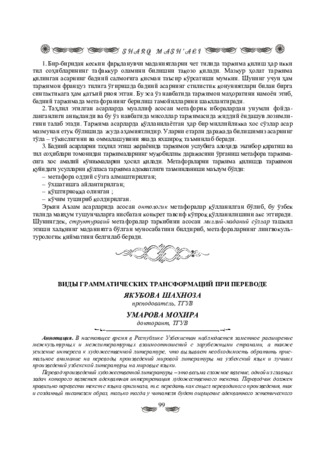
Types of grammatical transformations in translation
Currently, in the Republic of Uzbekistan there is a noticeable expansion of intercultural and inter-literary relations with foreign countries, as well as an increase in interest in fiction, which makes it necessary to pay close attention to translations of world literature into Uzbek and the best works of Uzbek literature into world languages. Translation of works of fiction is a very complex phenomenon, one of the main tasks of which is an adequate interpretation of the literary text. The translator must correctly translate the text from the original language, i.e. to convey both the meaning of the translated work and the image created by the writer, only then the reader will have a feeling of an adequate aesthetic perception of what he read. To translate correctly the conceptual and emotional content of a work, translation transformations help. According to Komissarov, translation transformations are formal-semantic in nature, transforming the form and meaning of the original units. That is, translation transformations are a method of translation used in the translation of various original texts in cases where for a word from the original language there is no correspondence in the translated language or the existing word cannot be used in this context In this article, one is considered. In this paper, one of the important aspects of translation studies is considered - grammatical transformations. When working on them, such types of transformations as grammatical substitutions,combined sentences, decomposition of sentences, literally translation will be considered. As a material for the study of examples of grammatical transformations, the material of P. Kadyrov’s novel “Yulduzli tunlar. Bobur ” and its translations into Russian (made by Y. Surovtsev and published under the title,“ Babur ”) and into Urdu from Uzbek (made by Manzur Salim and published under the title translated into Urdu" نیدلاریہظ رباب "). It should be noted that the translations were made from Uzbek into Russian, and already from Russian into Urdu. The article considers and systematizes lexical transformations that occur during translation into multisystem languages.
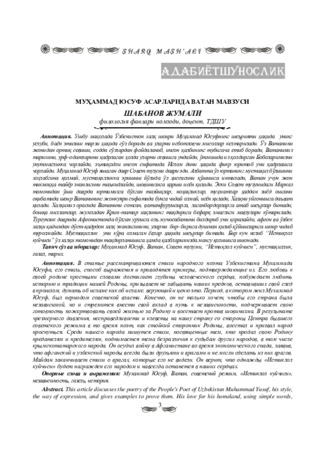
Muhammad Yusuf asarlarida watan mavzushi
This article discusses the poetry of the People's Poet of Uzbekistan Muhammad Yusuf, his style, the way of expression, and gives examples to prove them. His love for his homeland, using simple words, reaches the depths of the human heart, encourages them to love the history and traditions of our country, urges them not to forget our ancestors who left their mark on the past, to think about Islam as a believer. The period in which Muhammad Yusuf lived was the period of the Soviet regime. Of course, he not only wants his country to be independent, but also strives to contribute to the path to independence, emphasizes his readiness to sacrifice his life for the Motherland, and rebels against chauvinism. As a result of the excessive pressure, injustice and slander against our country by the Center of the former Soviet regime at that time, the poet, as a staunch supporter of the Motherland, rebelled and called on the people to wake up. Poems dedicated to the traitors and traitors who sold their homeland are written among our people, and the theme of indifference to the fate of other nations, including the Crimean Tatar people, is raised. He denounced the war in Afghanistan during the stagnation, saying that the Afghan and Uzbek peoples have always been friends and enemies, and could not bear to make them enemies. Independence ends poems about enemies who could not see him. He believes that one day "Istiqlol kuychisi" will be awarded by his people and will remain in our hearts forever.
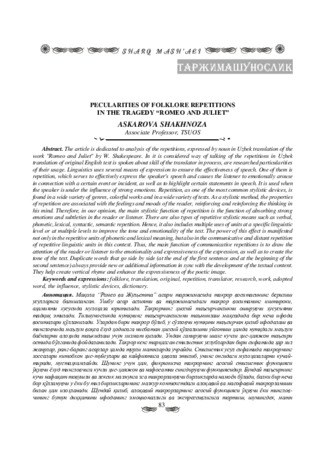
Pecularities of folklore repetitions in the tragedy “Romeo and Juliet”
The article is dedicated to analysis of the repetitions, expressed by noun in Uzbek translation of the work "Romeo and Juliet" by W. Shakespeare. In it is considered way of talking of the repetitions in Uzbek translation of original English text is spoken about skill of the translator in process, are researched particularities of their usage. Linguistics uses several means of expression to ensure the effectiveness of speech. One of them is repetition, which serves to effectively express the speaker's speech and causes the listener to emotionally arouse in connection with a certain event or incident, as well as to highlight certain statements in speech. It is used when the speaker is under the influence of strong emotions. Repetition, as one of the most common stylistic devices, is found in a wide variety of genres, colorful works and in a wide variety of texts. As a stylistic method, the properties of repetition are associated with the feelings and moods of the reader, reinforcing and reinforcing the thinking in his mind. Therefore, in our opinion, the main stylistic function of repetition is the function of absorbing strong emotions and subtleties in the reader or listener. There are also types of repetitive stylistic means such as verbal, phonetic, lexical, syntactic, semantic repetition. Hence, it also includes multiple uses of units at a specific linguistic level or at multiple levels to improve the tone and emotionality of the text. The power of this effect is manifested not only in the repetitive units of phonetic and lexical meaning, but also in the communicative and distant repetition of repetitive linguistic units in this context. Thus, the main function of communicative repetitions is to draw the attention of the reader or listener to the emotionality and expressiveness of the expression, as well as to create the tone of the text. Duplicate words that go side by side (at the end of the first sentence and at the beginning of the second sentence) always provide new or additional information in sync with the development of the textual content. They help create vertical rhyme and enhance the expressiveness of the poetic image.

Frequency of words in socio-political terms
This article describes the development of an algorithm for extracting socio-political terms from Chinese socio-political texts and determining the frequency of words in socio-political terms. Frequency tables of socio-political terms in Chinese were compiled, analyzed using methods of experimental and component analysis, and tables of socio-political terms were compiled. The article describes methods for automatically extracting one or two polysyllabic morphemic hieroglyphic words from one word or the main text. Five different options for calculating the "terminology" of phrases were considered. The experiments were carried out on three datasets from different fields of knowledge. The methods of joint assessment are proposed and the results of the comparative assessment of the methods are presented. As an example of a possible practical use of the results within the framework of the developed system, methods for calculating frequencies with the corresponding tables are described.
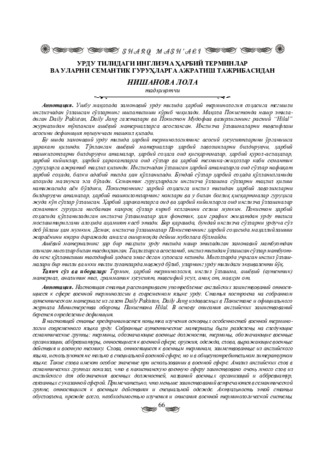
From the experience of English military terms in Rdu and their semantic grouping
The present article considers of current military vocabulary borrowed from English to Urdu. The data for the research were collected from authentic materials of popular newspapers such as Daily Pakistan, Daily Jang and the official magazine of Pakistan Armed Forces Hilal. The newspapers and magazine were chosen as a source because its language considered simple communication language of society. As English and Urdu languages have been in close contact during the British colonization of the sub-continent, the present study also outlines factors involved in borrowing from English to Urdu and shows the influence of English on Urdu. This article attempts to study the main features of the military terminology of Urdu language. The collected authentic materials were divided into the following semantic groups: terms for military positions, terms for military organizations, abbreviations related to the military sphere, weapons, clothing, words expressing military action and equipment. English loanwords of military terms are used not only in the military, but also in common literary language. Such words have special meaning when they are used in the military. Analysis of English loanwords in semantic groups showed that a lot of words were borrowed in military positions, names of military organizations and abbreviations. We can see that military operations and uniforms semantic group use less English loanwords than other groups. Based on analysis, we can predict with a high degree of certainty that it is no coincidence that these borrowings are used in the press. They are available in both bilingual and monolingual dictionaries.
The problem of classifying attributive adverbs in the Dari language
An adverb is a lexico-grammatical class of unchangeable, as a rule, words denoting a sign of an action, quality or object and acting in the syntactic function of a circumstance or definition, less often of a predicate. The adverb in all languages of the world belongs to the late parts of speech, the formation process of which continues to the present day. At the same time, words belonging to this category still retain their functions in other parts of speech from which they were formed. Another distinctive feature of the adverb is the conceptual heterogeneity of the class of words in comparison with other parts of speech. Based on the above, we can say that there are many definitions of adverbs in Afghan and Iranian studies. Previously, the works of Arab scholars served as the basis for studying the grammar of Dari and the Persian languages; today, Afghan and Iranian philologists admit that there are significant differences between Arabic and their languages, and therefore, in studying the grammar of their language, they try to take into account the grammatical features exclusively Farsi. It should be noted that there is an activity of Iranian philologists in the field of writing scientific articles and books devoted to the interpretation of a particular grammatical issue, the attention of researchers to the structure of syntax has increased. We have analyzed a number of works on the grammar of the Dari and Persian languages, which touch on the question of parts of speech and minor members of a sentence. Below is a brief description of some works on the grammar of the modern Dari and Persian languages, in which the question of our research is most fully considered. In world linguistics, the Dari language is not widely studied, like the Persian language. In Iranian studies, in the scientific description of this language, it is mainly noted that it differs from the modern Persian language. In the Dari language, as well as in the Persian language, the authors consider the adverb from a morphological and syntactic point of view. In the course of our research, we analyzed the works related to the modern Dari language, as well as unique works that are being republished for the second time in Afghanistan
A linguopragmatic analysis of speech etiquette units expressing greetings and wishes in Korean
Today, the relations between Uzbekistan and the Republic of Korea are becoming more active. In this regard, it is natural that there is an interest in understanding the ethnic identity of the Korean people. Despite the existence of a universal system in international relations, the Korean people still adhere to traditional forms of morality. In our country, there are agencies of the Republic of Korea in various fields, companies working on the basis of joint projects, and it is obvious that in these offices also work the citizens of our country. Therefore, in the current process of globalization, the study of behavior, speech culture and ethics of various linguistic and cultural communities is relevant in all respects. Morality is every action and its content, and manners are the moral direction, its form. Etiquette is inseparable from morality. A person's morals, in particular, are reflected in the tone of his speech, speech, appearance (dress), manner of communication, and so on. Greetings, introductions, treatment, job interviews, congratulations on various holidays, and observance of public order are all part of the moral code. At the same time, it is important to know about the rules of reception at work, sitting at the table.
On the issue of the study of the problem of the actual division of the sentence in the Azerbaijani and Japanese languages
This article is devoted to the study of the degree of knowledge of the problem of the actual division of the sentence in. This problem is one of the most important problems of the descriptive syntax of the Azerbaijani Japanese language. The main emphasis is placed on the issues of the structural distribution of the theme and rhema in the Azerbaijani and Japanese languages. A number of promising directions have been identified that require their solution in this area of Azerbaijani and Japanese linguistics.
Conceptual interaction between metaphor and metonymy in cognitive linguistics
There is no clear distinction between metonymy and metaphor. Specifying metaphor-metonymy interaction is a difficult task, particularly differentiating the two cognitive mechanisms from each other. There are a wide variety of opinion. In this paper we look mainly at two important issue, (i) what causes this interaction between metaphor and metonymy and (ii) how these two distinctly different processes blend. In Cognitive Linguistics metaphor and metonymy have both been explicitly recognized as central to a theory of knowledge organization. Metaphor and metonymy have both been described by Lakoff and his co-workers as mappings between conceptual domains. By means of metaphor we understand and reason about one conceptual domain in terms of another. Metonymy is a multilevel cognitive mechanism that can operate at the grammatical, lexical, syntactic, phonological, and discursive levels. According to cognitive linguists, metonymy is not merely a figure of speech; it is also a way of thinking and conceptualizing. Cognitive linguists, distinguish between metaphor and metonymy in terms of the number of domains involved. If the source and target belong to the same superordinate domain, we have a metonymy. If the source and target belong to two different superordinate domains, then we have a metaphor.
Artistic functions of synonyms in Turkish tilak/appreciation/dua
One of the important factors in linguistics is the study of a particular language based on its national and historical characteristics. The research clearly shows a reasonable aspect. This aspect is based on scientific and theoretical views and methods based on comparative historical, systemic and structural, anthropocentric paradigms, which do not deny, but complement each other in the study of lexical synonyms. The study of linguistic and speech relations of lexical synonyms determines the development of many rapidly developing areas of linguistics. Ensuring the effectiveness of the practical use of linguistic means, he puts on the agenda the scientific study of synonyms, based on the nature of the national language. The study of semantic and pragmatic relations between synonymous lexemes is one of the most pressing problems of modern linguistics. In our article, we will focus on the issue of improving art, distinguishing meaning from synonymous strings used in Turkish wishes/ applause/prayers. Turkish linguistics developed rapidly and reached its peak, the importance of national and cultural factors made it a priority to increase the volume of research in various fields of science. Linguistic and speech relations of lexical synonyms used in Turkish wishes, applause/prayers, in particular, the structure of synonymous lexemes, semantic volume, speech position, the issue of synonyms, their pragmatic content, unification and regulation of synonyms in this article. In this context, the widespread use of synonymous series in modern consumption, a multifaceted complex analysis of speech and linguistic relations of lexical synonyms shows the relevance and importance of the topic.
The creation of fam xui ton in the context of the formation of the new era Vietnamese novel
This article is based on the principles of formation and development of New Age Vietnamese short stories. In it we can see the peculiarities of the Vietnamese short story of the early twentieth century, in particular, several short stories by Fam Zyui Ton, and get acquainted with new directions in the writer's work. Also, in the process of analyzing the short stories, it is obvious that the writer tried to beautifully and skillfully depict the spiritual and cultural values, traditions and customs of Vietnam through each of his works. In the context of active literary relations, it is very important for every nation to preserve its identity in the conflict of influences. Because as a result of the influence of such universal literary relations, the literary trends and currents that emerged in the West had a great influence on the Vietnamese novel within the framework of artistic thinking. At the same time, the Vietnamese writer Pham Zui Ton, who wrote in the second half of the twentieth century, wisely used modern trends and artistic expression to create new stories and short stories that were in line with the Vietnamese people's worldview, national characteristics, lifestyle, values and even important aspects of religious thought. is one of the writers. In this article, several stories by Fam Zyui Ton are analyzed using examples. All the examples involved in the analysis further reveal the diversity of creative methods and directions, as well as the specificity of the creative style. After all, the scenes of life depicted in each work, interpersonal relationships, their dialogues, as well as the writer's unique artistic style are very natural and sincere. The study of the principles of formation and development of the Vietnamese novella of the new period helped us to identify, understand, and distinguish between the changes in Vietnamese literature of that period, the first half of the twentieth century, the renewal of the literary process, the peculiarities of traditional realism and romanticism. allows you to visualize the literary environment.
Scientific legacy of Ghulam Ghavs Khaybari
This scholarly article examines the life and creative biography of the famous Afghan writer and literary scholar, researcher Ghulam Ghaws Khaybari, and covers a wide range of information about the author that is still known. His time at Delhi University in India and his tenure as director of the Khyber Pakhtunkhwa Radio speaker and the «Pashtun Jag» (Voice of Pashtun) magazine are widely covered. Ghulam Gavs Khaybari is known as a Pashto – speaking writer and his works of art are studied throughout his career. It discusses the main ideas of the work of art and the problems it raises. The article also provides a detailed list of Ghulam Gavs Khaybari's previously published works of art and research.
In the stories of Orkhan Kamal, the reality of the period is expressed in the spirit of the literary hero
This article analyzes the works of the talented writer of Afghan storytelling, Rahnavard Zaryab, in particular, his stories such as “Photography Teacher”. Unlike traditional Afghan writers, the author is interested in a description of the processes taking place in the human heart. He tries to express an inner psychological attitude towards reality rather than incident is a priority. A number of the author's stories are characterized by a desire to uncover such aspects of the human psyche. At the same time, the author enriches the narrative with a variety of scenes, depicting the processes taking place in the spirit of the hero. In order to broaden the story, the story was compared with the story of Uzbek writer Nazar Eshanqul's “The man who led the monkey”.

