Vol. 2 No. 7 (2024)
Articles

PRIVATE INDICATORS OF THE SERVICES SECTOR IN THE DIGITAL ECONOMY
This article pays special attention to private indicators of the service sector in the context of the digital economy. In the context of the digitalization of the economy of our country, the method of regional approach in assessing the development of the service sector is also important for developing effective management decisions in this regard, improving the method of assessing the services provided. in the regions in the context of the digital economy in terms of volume per capita, proposals and recommendations are given

IMPLEMENTATION AND IMPROVEMENT OF QUALITY INDICATORS IN EFFECTIVE CASH FLOW MANAGEMENT BASED ON FOREIGN EXPERIENCE
The article introduces the authorʼs definition of the content of “cash flows" and suggests additional qualitative indicators of cash flows: intensity, liquidity, balance. The theoretical provisions of the methodology for analyzing cash flows in business entities have been supplemented. That is, the authorʼs definition of the content of “cash flows” is given and additional qualitative indicators of cash flows are disclosed. As a result of the research, the concepts of management and analysis of cash flows have been improved using formulas of intensity, liquidity, and equilibrium.

THE ROLE OF INNOVATIVE ACTIVITY OF HIGHER EDUCATION INSTITUTIONS IN THE DEVELOPMENT OF INNOVATIVE ECONOMY IN THE REGION
This article provides information about the main directions of development of the innovative economy of the region, the role of higher educational institutions. The innovative activity of higher educational institutions, various approaches to it, and indicators of financing innovative activity are analyzed. The principles and conditions for innovative development of higher educational institutions were also studied. Scientific conclusions and recommendations have been developed for further expansion of the relationship between education, science and business, commercialization of innovative developments and results of scientific research in higher educational institutions.

GREEN INNOVATION AND DIGITIZATION: A CATALYST FOR SUSTAINABLE DEVELOPMENT IN UZBEKISTAN
The increasing global focus on sustainable development has prompted a growing interest in understanding the roles of green innovation and digitization in fostering economic, environmental, and social sustainability, particularly within emerging economies like Uzbekistan.This study employs Structural Equation Modeling (SEM) to investigate the pivotal roles of green innovation and digitization in fostering sustainable development within the context of Uzbekistan, emblematic of challenges and opportunities for emerging economies. Through a comprehensive conceptual analysis, the research assesses the impact of these initiatives on economic growth, environmental conservation, and social equity. The findings reveal significant contributions of green innovation and digitization to sustainable development, manifested in heightened economic efficiency, reduced environmental degradation, and enhanced social well-being. Emphasizing the indispensability of institutional support, financial incentives, and stakeholder engagement, the study underscores the imperative for effective adoption and integration of sustainable practices and technologies.

THE MAIN PROBLEMS AND IMBALANCES OF TAX POLICY IMPROVEMENT
In this article, the scientific-theoretical content of the tax policy and strategy and the economic conditions for its occurrence are to ensure the effectiveness of the tax-budget system. Tax policy plays a very important role in the economic policy of any country. Tax policy is closely related to other economic policies of the state and influences them. Correct development of tax policy and determination of its strategic and tactical directions is a very urgent and complex process.

FEATURES OF CREATION OF A LEGAL FRAMEWORK FOR THE ISLAMIC BANKING SYSTEM IN SELECTED CENTRAL ASIA COUNTRIES
This article examines the unique aspects of the experience of some countries in creating a legal framework for Islamic banks, which have gained their place in the global financial market and have shown stable growth rates. Scholarly commentary is presented on the experiences of neighboring countries such as Tajikistan and Kazakhstan, whose systems of government are similar to those of Uzbekistan and which want a democratic system. Some points are highlighted that should be paid attention to by a country that has begun to create a legal framework for Islamic banking. A study was conducted of the impact of legislative changes in leading countries.

IMPORTANT PRIORITIES AND FOREIGN EXPERIENCE OF TAXATION IN UZBEKISTAN
In this article, the important aspects of improving the taxation system in our country, the experience of foreign countries in taxation, as well as the scientific and theoretical views and ideas of foreign and local scientists were studied. Foreign experiences in taxation were analyzed, and directions that could be put into practice were suggested

THE ROLE OF EXCISE TAX IN THE FORMATION OF THE REPUBLICAN BUDGET AND DIRECTIONS FOR INCREASING ITS FISCAL SIGNIFICANCE
Excise tax is a critical component of government revenue and makes a significant contribution to government revenues around the world. This tax is imposed on specific goods, such as alcohol, tobacco and fuel, in order to generate revenue and regulate consumption. This article provides the composition of excise tax payers, the role of excise taxes in generating state budget revenues of the Republic of Uzbekistan, as well as recommendations for improving the efficiency of administration of this tax.

THE ROLE OF BANKS IN THE DEVELOPMENT OF THE GREEN ECONOMY
This article shows how important it is to transition to a green economy as a result of global climate change. Also, due to environmental and social problems, the priority tasks of green economy development and issues of increasing the role of banks in the development of green economy, environmental and social risks in banks and their assessment, green loans, green bonds expansion are presented.

ISSUES OF IMPROVING THE TAX COLLECTION MECHANISM INTRODUCED IN THE TAX ADMINISTRATION
In this article, improvement of tax collection mechanism, improvement of service and education of taxpayers, simplification of tax system and procedures, development of effective communication channels between taxpayers and tax authorities, improvement of tax collection mechanisms. In addition, the theoretical and practical aspects of the trends in the development of relations that the formation of trust and perception of justice and the use of effective coercive measures increase compliance.

ASSESSMENT OF ECOLOGICAL CHARACTERISTICS OF DEVELOPMENT OF FOOD SERVICES IN TOURISM AND HOTEL INDUSTRY
The article presents the theoretical basis for assessing the environmental characteristics of catering enterprises engaged in preparing and selling food products based on scientific hygienic requirements of the national economy and consumer service, as well as the development of catering in the tourism sector and hotels.

ORGANIZATIONAL AND METHODOLOGICAL ISSUES OF OPERATIONAL RISK MANAGEMENT IN COMMERCIAL BANKS
This article discusses the important role of managing operational risks in the banking sector, with a detailed analysis of this issue in the context of commercial banks in Uzbekistan. Significant changes are being observed in the countryʼs banking system, and managing operational risks is becoming an integral part of ensuring financial stability. The article delves deeply into the organizational and methodological challenges banks face in their risk management processes. The insights and recommendations presented in the article are hoped to serve as a foundation for future research and for developing strategies to manage operational risks in the local banking sector.

WAYS OF EXPANDING THE SCOPE OF BANKING SERVICES IN UZBEKISTAN
This article is considering expanding the scope of banking services of commercial banks operating in Uzbekistan. As part of the study, the author analyzed practical data from commercial banks. Based on the results obtained, existing problems in expanding the scope of banking services of commercial banks and developing proposals for their elimination were identified.

STATE SUPPORT OF INSURANCE AS A TOOL FOR AGRICULTURAL RISK MANAGEMENT
Insurance of agricultural producers occupies an important place among the instruments of state support for agriculture, based on this, this article discusses the issues of state support for insurance.

HISTORICAL ASPECTS OF TOURIST SITES LOCATED IN KHOREZM
The article discusses the development of the tourism infrastructure of Khorezm, improvement of tourist routes and services in the region, demonstration of tourism opportunities, improvement of the infrastructure of additional facilities for tourists, training, retraining and advanced training of tourism specialists.
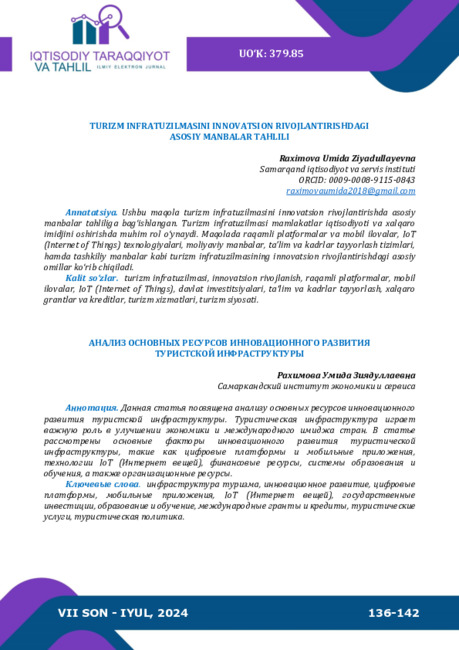
ANALYSIS OF THE MAIN RESOURCES FOR INNOVATIVE DEVELOPMENT OF TOURISM INFRASTRUCTURE
This article is devoted to the analysis of the main resources in the innovative development of tourism infrastructure. Tourism infrastructure plays an important role in improving the economy and international image of countries. The article considers the main factors in the innovative development of tourism infrastructure, such as digital platforms and mobile applications, IoT (Internet of Things) technologies, financial resources, education and training systems, and organizational resources.

ANALYSIS OF THE STATE AND DIRECTIONS OF DEVELOPMENT OF THE SPHERE OF TRADE IN THE BUKHARA REGION
The article presents an analysis of the dynamics of economic indicators of the trade sector of the Bukhara region in 2012-2022. Based on the analysis, the dynamics of growth in the volume of retail trade, the number of business entities providing retail trade services, the dynamics of the period of retail trade and trade turnover in the Bukhara region are determined. Against the background of an increase in the share of imports and a decrease in the number of employees in the industry, proposals have been developed to increase the competitiveness of trade services by increasing labor productivity, introducing innovations into the industry, and organizing additional trade services.

INTERNATIONAL EXPERIENCE OF TOURIST PRODUCT DIVERSIFICATION
Tourist product diversification is a strategic approach employed by global destinations to enhance their appeal and sustainability by broadening the range of attractions and activities available to visitors. This paper explores international experiences of tourist product diversification, examining case studies from diverse regions including Europe, Asia, North America, Africa, and South America. The research highlights key drivers of diversification, including economic stability, environmental sustainability, and cultural preservation. Case studies from Spain, Thailand, Japan, and other regions illustrate successful diversification strategies and their impact on local economies and tourism sustainability. The study contributes to the understanding of how diverse destinations manage and leverage tourism diversification to achieve long-term success and sustainability..

THE MAIN ASPECTS OF ATTRACTING FOREIGN INVESTMENTS INTO THE ECONOMY AND MANAGING INVESTMENT PROJECTS
This article analyzes the importance of foreign investment and its role in the development of the national economy, which is analyzed based on statistical data. Also, the article extensively covers existing problems in the effective management of investment projects involved in the national economy and what measures should be used to activate their prevention.

OUTSOURCING SERVICES AND ITS THEORETICAL BASICS
This article explores outsourcing services and its theoretical foundations, which the author analyzed and separated into approaches the definitions of most scientists. Also, the results of the introduction of outsourcing services in all sectors of the economy are studied. Opinions have been expressed about the development of outsourcing services in local areas, or the use in the system of health, higher education.

THE USE OF ADVANCED FOREIGN EXPERIENCE IN IMPROVING INITIATIVE BUDGETING IN UZBEKISTAN
This article examines the practice of implementing initiative budgeting in Uzbekistan, and borrows ideas from the experience of foreign countries. The study aims to assess the effectiveness of proactive budgeting as an approach to public finance management. The article analyzes various methods used in foreign countries, assesses their flexibility and application in the conditions of Uzbekistan.

PROBLEMS OF INFRASTRUCTURE DEVELOPMENT OF TOURISM INDUSTRIES IN UZBEKISTAN
In this article, the directions of implementation of the process of development of the infrastructure of tourism networks, the principles of innovative management mechanisms of the infrastructure of tourism networks, and the interrelationships between the problems of the development of the infrastructure of tourism networks and the directions of their elimination are analyzed.

FACTORS INFLUENCING THE DEVELOPMENT OF TOURISM IN THE REGIONS AND THE NEED FOR THEIR PLANNING
The article analyzes in detail the factors influencing the development of tourism in the regions. The role and importance of external and internal factors in the development of tourism are discussed.

FINANCIAL MARKETS VS. SECURITY MARKETS
This article examines the key differences between financial markets and security markets, highlighting their distinct characteristics, dynamics, and implications for market participants. Financial markets are primarily focused on managing market risks, leveraging complex pricing models, and executing trading strategies, with a regulatory framework centered on maintaining overall market stability. In contrast, security markets emphasize company-specific fundamentals, valuation techniques, and portfolio management, within a regulatory environment that prioritizes investor protection and mitigating individual security-related risks. The article discusses the importance of recognizing and adapting to these industry-specific differences in order to make informed decisions and effectively navigate the complexities of each market domain. It underscores the need for continuous learning, adaptability, and the incorporation of industry-specific reports, trends, and best practices. As the financial landscape evolves, with the increasing integration of technology and the growing emphasis on sustainability, the ability to differentiate between financial markets and security markets becomes even more crucial for professionals and investors seeking to optimize their performance and manage risks.

FORMS OF TAX CONTROL IN THE REFORM OF THE TAX SYSTEM AND WAYS TO IMPROVE IT
The article studied the reforms carried out in our country on the reform of the tax system, their results, the forms and importance of tax control in the further improvement of the tax system along with the scientific-theoretical views of foreign and domestic scientists. Proposals and conclusions have been made to ensure effective tax control.
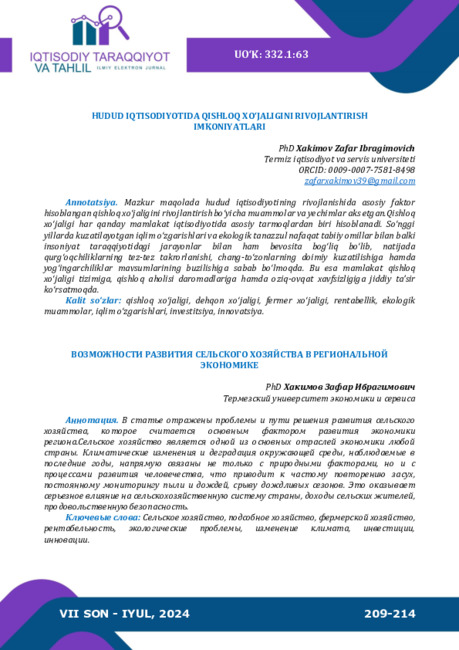
AGRICULTURAL DEVELOPMENT OPPORTUNITIES IN THE REGIONAL ECONOMY
This article reflects the problems and solutions for the development of agriculture, which is considered the main factor in the development of the regionʼs economy. Agriculture is one of the main sectors in the economy of any country. Climate changes and environmental degradation observed in recent years are directly related not only to natural factors, but also to the processes of human development, resulting in frequent recurrence of droughts, constant monitoring of dust and rains, and disruption of rainy seasons. This has a serious impact on the countryʼs agricultural system, the incomes of rural residents, and food security.

ANALYSIS OF PROJECTS IMPLEMENTED ON THE BASIS OF PUBLIC-PRIVATE PARTNERSHIP IN UZBEKISTAN
In this scientific article, public-private partnership (PPP) projects that serve to ensure effective cooperation between the state and private sector, develop infrastructure, and improve the quality of public services are analyzed and projects planned to be implemented in the future are described.

INFLUENCE OF ARTIFICIAL INTELLIGENCE TECHNOLOGIES DEVELOPMENT ON THE FINANCIAL MARKET
The creation of artificial intelligence and its widespread penetration into various sectors of the economy are causing the establishment of quality systems through highly efficient "smart" technologies. However, it is not known what the consequences of their daily development and perfection will be. The article examines the impact of the development and wide implementation of artificial intelligence on the financial market and its prospects as a result of its development based on information from international consulting companies.
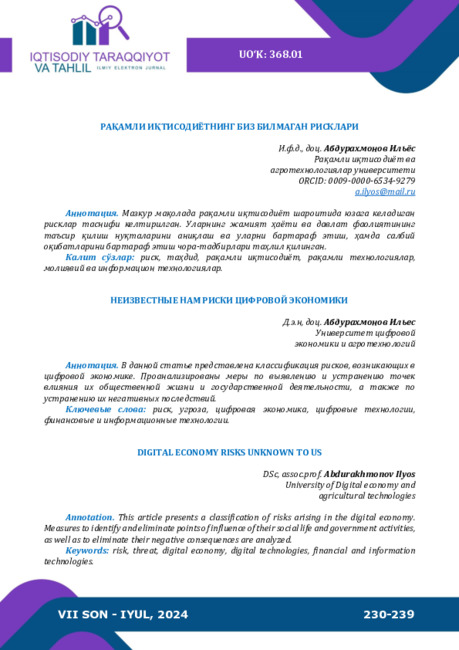
DIGITAL ECONOMY RISKS UNKNOWN TO US
This article presents a classification of risks arising in the digital economy. Measures to identify and eliminate points of influence of their social life and government activities, as well as to eliminate their negative consequences are analyzed.

ASSESSMENT OF INNOVATION ACTIVITY OF THE ENTERPRISE
The article, based on an analysis of the currently existing definitions of the term “innovative activity,” formulates its own definition. It was taken as a basis, when proposing a method for assessing the innovative activity of an enterprise, by assessing the intensity of introduced innovations according to the degree of their novelty.

FUNDAMENTALS OF ORGANIZING FINANCIAL FLOWS OF INSURANCE COMPANIES
The article theoretically and practically describes the cash flows of insurance companies, their classification, formation, sources of creation, discloses their characteristics, analyzes practical processes.

ANALYSIS OF FINANCIAL INDICATORS OF BANKS IN THE IMPLEMENTATION OF EFFECTIVE LENDING ACTIVITIES (IN THE CASE OF ICBC BANK)
The article describes the theoretical and practical aspects of the role of financial indicators of banks in the implementation of effective lending mechanisms in commercial banks. In particular, the composition of assets and liabilities of commercial banks, the profitability of assets and capital, the 10-year dynamics of problem loans in commercial banks and their share, as well as the 10-year dynamics of the amount of reserves created for them, were formed.

COMPARATIVE ANALYSIS OF DEVELOPMENT MODELS OF NATIONAL ECONOMIES
This article provides a comparative analysis of the economic development models of Scandinavian countries. Examples of countries such as Norway, Sweden, Finland, Denmark, and Iceland, which combine innovative economies with high taxes, are discussed in the context of their resilience to economic crises. These nations occupy top positions in authoritative global rankings, reflecting the success of their economic policies. The article examines the distinctive features of the Scandinavian economic models based on principles of social justice. Additionally, it analyzes the economic and social policies of each country and evaluates their effectiveness.

DIRECTIONS FOR IMPROVING THE SYSTEM OF TAXATION OF MINING AND METALLURGICAL ENTERPRISES
The article proposes issues of improving the taxation system in order to ensure the implementation of long-term strategies and programs in the development and prospects of the mining and metallurgical sector. In the opinion of the author, in order to further strengthen macroeconomic stability and achieve high economic growth, in order to produce competitive products, it is necessary to pay attention to issues of improvement in the collection of tax for the use of subsoil in the enterprises of the mining and metallurgical industry based on international experiences.

IMPROVING THE FINANCIAL ACCOUNTING OF ASSET IMPAIRMENT
Based on decision PC No. 4611 of February 24, 2020, “On additional measures for the transition to international financial reporting standards,” the article analyzes IFRS and develops scientific proposals and recommendations regarding the correct accounting of asset impairment in the reporting of enterprises that have received IFRS.

IMPROVING FINANCIAL MECHANISMS FOR ENSURING INVESTMENTS IN ECONOMIC DEVELOPMENT
This article pays special attention to the specific features of the investment environment in the development and attractiveness of the economy of our country. Today, intensifying the attraction of investments into the economy of our country, creating favorable conditions for attracting investments, introducing practical mechanisms for their legal protection and further improving the investment environment is one of the most important tasks in the field of economic development.

ANALYSIS OF THE IMPACT OF THE ORGANIZATION OF ISLAMIC BANKS ON THE ECONOMIC GROWTH OF INDIVIDUAL COUNTRIES
This article presents scientific comments on the research of Muslim economists on the influence of Islamic banks on the economic growth of the country. It is dedicated to reflecting the factors of sustainable development of Islamic banks in 2021-2022 and the pace of change. The position of Islamic banks in different regions of the world is analyzed. The reasons for the changes are indicated and explained. The effectiveness of changes in legislation on the creation of Islamic banks in the leading countries of the world has been studied.

SCIENTIFIC AND THEORETICAL FOUNDATIONS OF CLUSTERIZATION AND ITS ROLE IN THE DIVERSIFICATION OF THE AGRICULTURAL ECONOMY
This article addresses the issues related to the scientific-methodological, regulatory-legal, and organizational-economic support for the establishment and development of grain clusters. Based on the results of studying and analyzing types of clusters, the criteria for clustering and types of clusters are outlined. A multi-stage algorithm for the creation of regional and territorial grain clusters is proposed. The main problems hindering the process of establishing grain clusters are also analyzed, and recommendations for their elimination are provided.

THEORETICAL FOUNDATIONS AND FEATURES OF INSURANCE PRODUCTS DEVELOPMENT
The article analyzes the concepts of “insurance product” and “insurance service” provided by companies in the insurance market. A classification of insurance products available on the market and their types is presented, and the concept of creating insurance products is studied.

IMPROVING THE TECHNOLOGY OF ITS IMPLEMENTATION IN STRATEGIC MANAGEMENT
This article examines the issues of improving strategic management technologies aimed at ensuring adaptation to its variability in the conditions of the market economy.

FORMATION OF A DIGITAL MARKETING SYSTEM IN SMALL BUSINESSES
The article examines the role of digital marketing in small business and entrepreneurship, and examines the factors contributing to the development of small businesses.

FOREIGN EXPERIENCE OF TAXATION OF COMMERCIAL BANKS
The article is devoted to the foreign experience of taxation of commercial banks, and the research of foreign and domestic scientists are studied in the framework of the research. Also, a comparative analysis of the tax policy implemented by foreign countries and the lessons to be learned from it is presented, and a conclusion is formed at the end.

ECONOMETRIC MODELING AND FORECASTING OF INTERNAL AND EXTERNAL FACTORS AFFECTING PRODUCT COST
This article analyzes the economic significance of internal and external factors affecting product cost, as well as methods of econometric modeling and forecasting to assess their impact. Additionally, the article covers the practical application of econometric modeling and forecasting and their impact on the activities of manufacturing enterprises. Scientific proposals and practical recommendations are provided based on the research results.

USING FOREIGN EXPERIENCE IN IMPROVING THE CAPITAL MARKET
The article gives proposals for the development of the activities of corporations, increasing their activity in the capital market, investment financing of new modern projects, and further development of the economy through the capital market.

FORECASTING OF MACROECONOMIC INDICATORS OF THE REPUBLIC OF UZBEKISTAN USING THE ARIMA MODEL
This article examines the use of the ARIMA model for analyzing and forecasting the macroeconomic indicators of the Republic of Uzbekistan. The application of the ARIMA model allowed for the identification of stable trends and provided accurate forecasts for such indicators as gross domestic product (GDP), industrial production, investment in fixed capital, and aggregate household income.

THE ROLE OF MARKET PARTICIPANTS IN THE DIGITAL ECONOMY AS AN ACCOUNTING OBJECT
In this article, the essence of the economic category of the digital economy is scientifically and theoretically researched, the role of economic entities in the conditions of the digital economy, their socio-economic and economic activities, the impact of digital technologies on market entities, in particular, the organization and management of accounting in economic entities in this context. Issues such as importance are covered.

PROSPECTS FOR DIGITALIZATION OF EDUCATIONAL SERVICES IN INNOVATIVE ECONOMY
The article presents an analysis of the services provided by higher education institutions in the near future, trends in educational changes in currently available forms of education, and foreign experience in the digital transformation of higher education institutions.

ANALYSIS OF THE EDUCATIONAL SERVICES MARKET IN UZBEKISTAN
The purpose of this study is to analyze the current state of the educational services market in Uzbekistan, focusing on public and private institutions at various levels of education. This analysis is of scientific importance in the development of policies that increase the current state and quality of education in Uzbekistan, as well as competitiveness, and the author's analytical comments are presented.

SCIENTIFIC VIEWS ON THE USE OF DIGITAL TECHNOLOG
In this article, there are scientific views on the use of digital technologies to improve the efficiency of corporate management in foreign developed countries and joint-stock companies operating in our country, the study of the world experience in this area, the legal basis of corporate management and increasing its efficiency in our country, scientific definitions of efficiency indicators and their analysis, the impact of efficiency indicators on corporate management. , important indicators of efficiency, factors for evaluating the efficiency of corporate management, and issues of increasing the role of digital technologies in increasing the efficiency of corporate management are analyzed and the author's views are expressed.

WAYS TO USE THE BIOMETRIC IDENTIFICATION SYSTEM IN THE PROCESS OF BANK TRANSFORMATION IN UZBEKISTAN
In this article, the priority tasks of introducing modern technologies in the process of transformation of banks are researched, several priority tasks and stages that should be implemented in the widespread use of digital technologies in networks today are analyzed. Also, researches have been carried out on the introduction of identification systems in banks to determine the identity of the client.

THE ROLE OF COMMUNICATION SERVICES IN ECONOMIC DEVELOPMENT IN THE DIGITAL ECONOMY
This scientific article is devoted to the role of communication services in the development of the modern economy. Proposals and recommendations have been made that ensuring fast and high-quality circulation of information through communication services has today become the main criterion for the economy, development and prosperity of the country.

CHOOSING AN EFFECTIVE OPTION TO OPTIMIZE THE EFFICIENCY OF THE ORGANIZATION OF COTTON AND TEXTILE CLUSTERS
Today, serious attention is being paid to the implementation of the cluster policy of production organization in our republic. The first clusters were established in the cotton complex. The article examines the issue of choosing an effective option for optimizing the efficiency of the organization of cotton-textile clusters based on the development of the objective function of maximizing the added value and finding a solution. It is based on the fact that the form of organization of production is the most effective in creating added value.

ECONOMETRIC MODELING OF FACTORS AFFECTING SHARES OF JOINT STOCK COMPANIES
In the article, the influence of factors affecting the value of shares of joint-stock companies and an econometric model are formed. Also, the factors influencing the share price of joint stock companies were analyzed based on the data from 2015 to 2023. In particular, forecasts of multiplier coefficients calculated for the factors affecting the value of shares of joint-stock companies in our country "Kyzilkumtsement", "Uzmetkombinat", "Ko'kon Mechanical Plant" and "Kvarts" JSCs are presented. On the other hand, existing problems were identified with the forecast of the factors affecting the value of the share of the joint-stock company, and scientific proposals and practical recommendations aimed at their elimination were developed.

SOCIO-ECONOMIC NATURE OF DIRECT TAXES AND THEIR ROLE IN THE TAX SYSTEM
This article deals with ensuring the effectiveness of the tax-budget system in the new development strategy of our republic. Formulas for calculating the tax potential are given, as well as proposals for improving the tax policy, improving the development of existing innovative methods and methodological approaches in determining the needs of spending in the budget and the main aspects of equalization programs, and using a wide range of economic-mathematical modeling and forecasting methods.

DISTINCTIVE CHARACTERISTICS OF BANK PRODUCTS AND SERVICES, ANALYSIS OF THEIR IMPLEMENTATION
The article discusses the general characteristics of “banking products” and “banking services”, their specific features, as well as the introduction of new banking products and services.

THE IMPROVEMENT THE EFFICIENCY OF ECONOMIC POTENTIAL OF SMALL BUSINESSES AND PROBLEMS OF ITS IMPROVEMENT (IN ANDIJAN REGION)
This article focuses on analyzing strategies and mechanisms to enhance the economic potential of small businesses and private entrepreneurship, specifically in the Andijan region. It explores the critical factors affecting the development of small and medium-sized enterprises (SMEs) in the area, such as access to finance, innovation processes, educational programs, and government support. Utilizing statistical data and theoretical research, the author provides several recommendations to improve the business environment and stimulate entrepreneurial activity, aiming to foster sustainable economic growth and improve the quality of life for the region’s population.

INTRODUCTION OF EXCISE TAX IN UZBEKISTAN, ITS ECONOMIC NATURE AND LEGAL BASIS
Excise tax plays an important role in the formation of state revenues and regulation of the consumption of certain goods and services. This article reviewed the existing literature on excise tax administration, drew conclusions from advanced international experiences. It defines the main directions of improvement of control mechanisms, the main focus is on policy reforms, technological integration and capacity building in tax authorities.
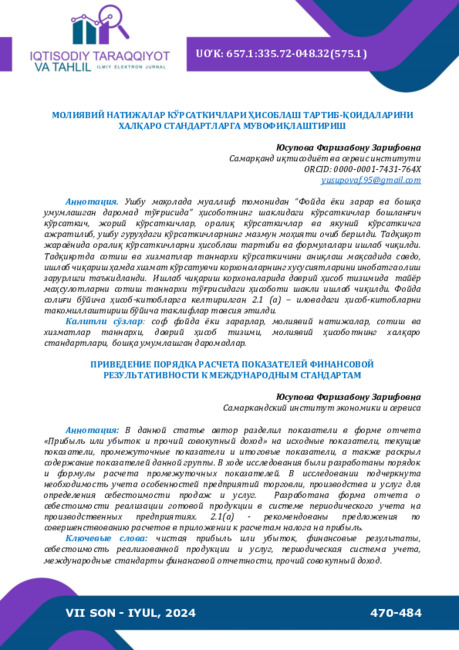
BRINGING THE PROCEDURE FOR CALCULATING FINANCIAL PERFORMANCE INDICATORS TO INTERNATIONAL STANDARDS
In this article, the author divided the indicators in the form of the “Profit or Loss and Other Comprehensive Income” report into initial indicators, current indicators, intermediate indicators and final indicators, and also revealed the content of the indicators of this group. During the study, the procedure and formulas for calculating intermediate indicators were developed. The study emphasizes the need to take into account the characteristics of trade, manufacturing and service enterprises to determine the cost of sales and services. A report form has been developed on the cost of sales of finished products in the periodic accounting system at manufacturing enterprises. 2.1(a) - proposals for improving calculations in the annex to income tax calculations are recommended.

