All articles - Neuroscience and Neurology
Number of articles: 649
-
 The features of the clinical course and treatment of non-traumatic intracerebral hemorrhages in childrenClinical features of the course of 88 patients with non-traumatic intracerebral hemorrhages (NTIH) were studied. The main causes of the onset of NTIH were late hemolytic disease of newborns (61.4%) and hemorrhages of unexplained etiology (26.1%). The NTIH was more likely located subdural (47.7%) and intracerebral (25.0%), with them children often (38.6%) enter the in-patient department, every third (33.0%) in extremely difficult conditions. The Determination of the regularities of the clinical current non-traumatic intracerebral hemorrhages promotes the identical course of the treatment to early discovery disease and under- taking.
Journal problems of biology and medicine -
 Dynamics of clinical manifestations of parkinson disease on the treatment background tidomet forteThe study was based on patients with Parkinson's disease (PD). The disease was assessed ac-cording to the Hen-Yar scales (Hoehn M. & Yahr M., 1967), UPDRS (Unified Parkinson's Disease Rating Sca-ley), MMSE (Mini-Mental State Examination). Treatment of patients was carried out in groups with the addi-tion of tidomette forte preparation. These studies showed a decrease in tremor, rigidity. Decreased postural instability, disorders in walking. This confirms the effectiveness of this drug in patients with PD
Journal problems of biology and medicine -
 Evaluation of clinical progression of parkinson disease by the results of a prospective researchThe aim of the work is to study cognitive impairment in 90 patients at the early, advanced and late stages of Parkinson's disease. Clinical and neurological studies performed through quantitative evaluation of motor and non-motor damage according to the Hen-Yar scale, and cognitive impairment based on the method of A.R. Luria. The study showed that neurodynamic and regulatory cognitive impairments were predominant. Severity of cognitive impairment was associated with age (p <0.05), stage and duration of the disease (p <0.05) as well asdefined daily dose of levodopa (p <0.05). Disturbances of regulatory and visual-spatial functions more often detected in patients at the extended and late stages and were more associated with axial disorders (postural instability, walking irregularities, congelation)
Journal problems of biology and medicine -
 Autism in children and its influence on the somatic and neurologic statusIn the structure of somatic pathology in children with autism, GI diseases, allergic and immunopatholo-gy are significantly more often diagnosed. Neurological status in them was characterized by diffuse micro-symptomatics in the form of dissociation of tone, changes in reflexes (mild asymmetry of tendon and periosteal reflexes), low speech production and the presence of a defect in social communication
Journal problems of biology and medicine -
 Structural changes in aponeuroses in patients with postoperative ventral hernias of different age groupsObjective of the study. To determine the structural differences of aponeuroses in different age groups of patients with postoperative ventral hernias. Materials and methods. Comparative orphological studies of aponeuroses of 36 patients operated in the First and the Second hospitals Samarkand State Medical Institute for postoperative ventral hernias aged 40 to 76 years. Patients are divided into 3 groups according to the WHO age classification: Group I included patients 45-59 years old; Group II 60-74 years old; and the Group III in-cluded patients 75-90 years old. The biopsy specimens of the anterior abdominal wall, obtained during hernio-plasty were subjected to histological examination. Standard pieces of aponeurotic abdominal wall tissues taken during surgery were fixed in a 10% formalin solution on phosphate buffered saline for light microscopy exami-nations. Paraffin sections were stained with hematoxylin and eosin (H&E). Results. Investigation of biopsy specimens of aponeuroses and adjacent muscle tissue in patients of different age groups have revealed signifi-cant structural differences that can determine the frequency of hernias of the anterior abdominal wall and their recurrences. Conclusions. The study discovered that with advancing age significant structural changes occur on the aponeurosis of abdominal rectal muscles. The nature of these changes, especially the disruption of the collagen fiber arrangements, suggests that these structural changes are responsible for the weakening of the aponeurosis.
Journal problems of biology and medicine -
 Anosognasia in patients with acute period of ischemic blood-strokeIn acute period of ischemic blood stroke, 80 patients were examined to establish co-relation of frequency neurological and neurophysiological symptoms. During examination were used following methods: MRT, CT, NIHSS scale and “Anosognosia Score”. In result of research were diagnostocated that patients in acute period of ischemic blood-stroke who had cognitive and excitor anosognasia with dysplasia of neurologic and motor disfunction compare to patients who had better self control developed more severely
Journal problems of biology and medicine -
 Chronic pain syndrome in diseases of the peripheral nervous systemWe have examined 146 patients, 71 patients with radiculopathy, 20 with plexopathy, 23 with compres- sion-ischemic neuropathies, 32 with chronic diabetic polyneuropathy. For this study we used the following methods: MRI, CT, X-ray, DN 4 questionnaire, electroneuromyography, Spielberger–Khanin questionnaire, Montgomery-Asberg depression rating scale, asthenia scale (MFI-20). The study showed that the clinical pic-ture, narure and severity of chronic pain syndrome in diseases of the peripheral nervous system does not di- rectly depend on the degree of damage to the peripheral nerves, being determined by the degree of central mechanisms of somatosensory system regulation involvement in the pathological process
Journal problems of biology and medicine -
 Influence of alcohol influence on the peculiarities of the curve of brain-brain traumaAlcoholic intoxication leads to more severe injuries: those who suffer from alcohol intoxication. Mor-tality in patients with severe craniocerebral injury reaches 30%. The time of recurrence of cerebral and focal symptoms with a combination of trauma with alcohol intoxication is longer than in sober patients, on average by 28-30%.
Journal problems of biology and medicine -
 Morphology of the hydraulic system of the brain in tanathogenesis from acute blood lossThe morphology of the perivascular space and vascular plexuses of the cerebral ventricles of rats during thanatogenesis from acute hemorrhage was studied. Their morphological changes in this process have been studied.
Journal problems of biology and medicine -
 Epilepsy is a chronic disease of the brain, which is characterized by repeated (two or more) epileptic seizures, not provoked by a direct cause, caused by excessive neural discharges, accompanied by other clinical and paraclinical manifestations, the most important of which include changes in psi chiki and EEG [1, 3, 6, 9].
 -
 Transcranial dopplcrography was performed in 60 patients with diabetic polyneuropathy. At the same time, the duration of diabetes mellitus, as well as the stage of compensation, were taken into account. As a result of the study, it turned out that with diabetic polyneuropathy, premature and rapidly progressing atherosclerotic changes in cerebral vessels are detected, with the development of a stenosing process in them.
 -
 Сlinical-neurological, neurophysiological features of symptomatic epilepsyThe article considers the state of epileptic seizures and diagnostic indices of patients with epilepsy of ob-servation in 25 patients. The frequency of development of the disease was determined by various epileptic sei-zures. It was also based on the results of an EEG study of patients with a very important diagnosis of epilepsy. Most often, clinical manifestations of attacks were absans and focal motor attacks. The article describes the main pathological changes in the bioelectrical activity of the brain
Journal problems of biology and medicine -
 As a result of a study of 129 patients with epilepsy, a high frequency (73.6%) of associated psychopatho-logical disorders of anxiety and depressive nature was detected, with their prevalence in women (66.1%). Dis-tinctive clinical features of epilepsy associated with anxiety and depressive disorders are pharmacoresistance, the prevalence of simple partial ideatorial and emotional-affective seizures and the presence of affective disor-ders of the anxiety-depressive circle in history before the onset of the disease (79.8%)
 -
 Clinical diagnostic features of cns infectious defects in hiv-infected patientsAmong the observed patients, the predominant route of HIV infection was injection. The Epstein – Barr virus, Toxoplasma and Mycobacterium tuberculosis were the most frequent pathogens affecting the CNS in HIV-positive patients. The disease developed mainly in young people, regardless of gender. Infectious lesions of the CNS in HIV-positive patients develop gradually and manifest themselves clinically against the back-ground of deep immunodeficiency
Journal problems of biology and medicine -
 Motor and non-motor damage in the early and late stages of parkinson’s diseaseIn patients with Parkinson’s disease, anxiety disorders investigated at early and late stages. For this, we used the following scales: To measure the severity of the movement the XEN-YARA scale, to check the final stage of motion defection “UPDRS” (Unified Parkinson`s Disease Rating Scale).As a result, in patients with Parkinson’s disease, anemia and movement disorders develop more often in the late stage of illness than in the earthy stage of the disease
Journal problems of biology and medicine -
 Haracteristics of alarm-depressive conditions in patients with ulcer disease and their correctionBased on the results obtained, patients with peptic ulcer disease should be referred to the risk group for the development of anxiety-depressive disorders, which it is advisable to consult a psychoneurologist during treatment. With comorbidity of peptic ulcer and anxiety-depressive disorders, in addition to eradication thera-py, psychopharmacological therapy is appropriate for patients
Journal problems of biology and medicine -
 Features of cerebral hemodynamics in patients with epilepsy in gerontological practiceIn elderly patients with frequent epileptic seizures compared with older patients with infrequent epileptic seizures marked increase in performance linear systolic blood flow velocity in the study of cerebral veins and the development of compensatory mechanisms of venous outflow, indicating the presence of venous circulatory distress, manifested in violation of the venous outflow from the cranial cavity and is celebrated mainly in the later stages of cerebrovascular pathology
Journal problems of biology and medicine -
 Structure of neuropsychological impairment in patients with idiopathic and symptomatic epilepsyThe structure of cognitive disorders in patients with symptomatic epilepsy and idiopathic epilepsy. On the basis of the neurophysiological parameters of cognitive evoked potentials set specific disorders of higher cerebral functions in epilepsy, there were significant changes in latency and amplitude of P300, depending on the form of the disease. In the analysis of the relationship of indicators of psychometric tests and neurophysio-logical changes are revealed in all blocks of the implementation of cognitive function, more pronounced in symptomatic epilepsy.
Journal problems of biology and medicine -
 Comparative analysis of conditions of formation of persistent remissions in patients with opioid and cannabinoid dependence according prolonged catamnesisA comparative study of factors affecting the formation of stable remission in patients suffering from opioid and cannabinoid dependence. Studies have shown that certain differences in the characteristics of patients with opioid and cannabinoid dependence, cease taking of psychoactive substances
Journal problems of biology and medicine -
 Evaluation of results reconstructive surgery on the arteries infrainguinal zone in the immediate postoperative periodOperated on for chronic obliterating diseases of arteries in infrainguinal zone of 147 patients divided into 2 groups: op- erated by the method of reversed autovein (n=79) and operated by the method of using autovein in situ(n=68). In the imme-diate postoperative period thrombosis of grafts was 9.2% in group 1, 7.6% in the 2nd group. Each group performed one amputation at the hip level. Deaths cases are absent. Thus, during the femoro-distal bypasses by autovein excellent results are achieved with a method in situ, and in reversed autovein
Journal problems of biology and medicine -
 Evaluation of the effectiveness of physiotherapeutic treatment at the craniocervicalgiaComplication of the pathogenesis of cranioccrvicalgia and clinical polymorphism of the complex of symptoms reveals the need for a systematic approach to restoring healing procedures. The effectiveness of physiotherapy treatment in patients aged 18-35 years with craniocervicalgia was evaluated. Pathogenetic orientation and high efficiency of complex physiotherapeutic treatment were determined.
Doctor's Herald -
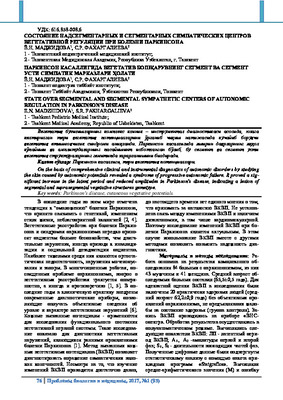 State over segmental and segmental sympathetic centers of autonomic regulation in parkinson's diseaseOn the basis of comprehensive clinical and instrumental diagnostics of autonomic disorders by studying the skin caused by autonomic potentials revealed a syndrome of progressive autonomic failure. It proved a sig-nificant increase in the latent period and reduced amplitudes in Parkinson's disease, indicating a lesion of segmental and suprasegmental vegetative structures gemetype
Journal problems of biology and medicine -
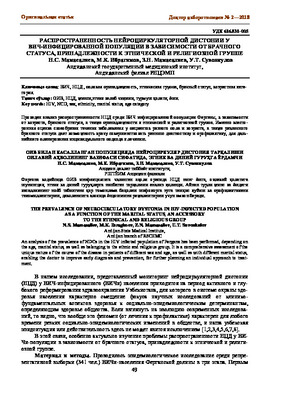 The prevalence of neurocirculatory dystonia in hiv-infected population as a function of the marital status, an accessory to the ethnical and religious groupAn analysis of the prevalence of NDCs in the HIV infected population of Fergana has been performed, depending on the age, marital status, as well as belonging to the ethnic and religious group. It is a comprehensive assessment of the unique nature of the course of the disease in patients of different sex and age, as well as with different marital status, enabling the doctor to improve early diagnosis and prevention, for further planning an individual approach to treatment.
Doctor's Herald -
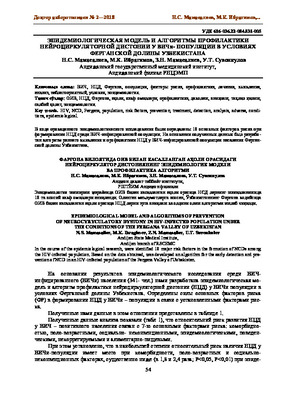 Epidemiological model and algorithms of prevention Of neurocyryculatory dystony in hiv-infected population under the conditions of the fergana valley of uzbekistanIn the course of the epidemiological research, were identified 18 major risk factors in the formation of NCDs among the HIV-infected population. Based on the data obtained, was developed an algorithm for the early detection and prevention of NCD in an HIV-infected population of the Fergana Valley of Uzbekistan.
Doctor's Herald -
 Clinical and laboratory aspects of alzheimer's type dementiaObjective of this research was studying the values of clinical and laboratory data’s indicators, to estab-lish interrelation between them at early diagnosis of Alzheimer’s type dementia. It’s surveyed in the conditions of a neurologic hospital of 40 patients (17 men and 23 women) aged till 65 years with Alzheimer’s type demen-tia with use of Hachinski’s scale, an assessment of the mental status, the battery of tests for an assessment of frontal dysfunction, the clock drawing test for an assessment of development of cognitive neuropsychological impairments. On the basis of research of patients, it is revealed that changes of laboratory data’s indicators correlated with cognitive and a mental condition of patients
Journal problems of biology and medicine
