All articles - Literature
-
 Qashqadaryo viloyati Yakkabog‘ tumani shevasining o‘zbek adabiy tilida tutgan o‘rnini o‘rganish muammolari
Современные тенденции инновационного развития науки и образования в глобальном миреMa’lumki, so‘nggi yillarda respublikamizda tilga bo‘lgan e’tibor jadal sur’atlarda rivojlanib bormoqda. Shu munosabat bilan yurtimizning turli hududlarida yashovchi aholi shevasining o‘zbek adabiy tiliga munosabati masalasini o‘rganish dolzarb masalaga aylandi. Ushbu maqolada Qashqadaryo viloyati Yakkabog‘ tumani Terak qishlog‘i shevasiga xos bo‘lgan oziq-ovqat nomlari leksikasini tahlil qilish va uning o‘zbekadabiy tiliga munosabati masalasini o‘rganish bosh mezon qilib olingan.
-
Without a deep study of the history of the text of classical works of art, it is impossible to talk about the progress of the science of textology. Because the concept of text history is one of the basic theoretical foundations of textual studies. "The history of the text includes all the processes from the investigation of the genealogy of the manuscript sources to the study of the worldview and ideas of the author and the scribe who copied the source, from the realization of the author's creative intention in the creation of the work to the study of its interrelated aspects with other literary monuments that are related to its creation to one degree or another" [6 ,9], it becomes more clear how important it is to study this scientific problem.
-
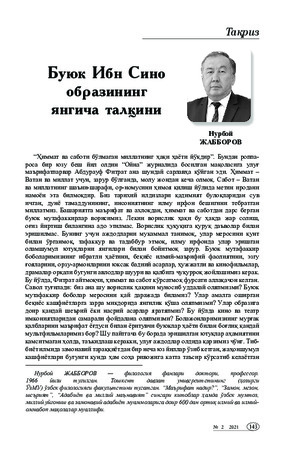 "A nation without courage and perseverance has no real life." Exactly one hundred and five years ago, the great enlightener Abdurauf Fitrat gave such a title to his article published in "Oyna" magazine. Courage - to sacrifice one's life for the sake of the country and the nation, if necessary. Sabot - is to be able to show the will to protect the honor and dignity of the country and the nation. We are a nation whose historical roots drank water from ancient springs, rocked the cradle of world civilization and humanity. We are the heirs of great thinkers who taught humanity about enlightenment and morality, courage and endurance. But the right of inheritance cannot be paid just by talking about it. The right of succession cannot be achieved by empty claims. For this, it is necessary to know the ancestors perfectly, to diligently study their heritage, to think and think, to enrich the universal achievements they have achieved in science and knowledge with new ones.
 -
 Text representation as one of effective methods of teaching students of national groups
Современные тенденции инновационного развития науки и образования в глобальном миреThis article discusses one of the possible approaches to assessing the content of oral monologue messages, which is based on the reproduction and interpretation of directly perceived semantic information in the text.
-
The great Azerbaijani poet Sheikh Nizami Ganjavi started a unique poetic phenomenon in world literature - khamsalik. Although it was written in Persian, it is known that the great poet's "Panj Ganj" reflects the Turkish thought and the Turkish spirit. The great Uzbek thinker Hazrat Alisher Navoi brought the poetic tradition started by Nizami Ganjavi to a high stage of development with his "Khamsa". According to Professor Almaz Ulviy, the author of remarkable scientific studies on Azerbaijani-Uzbek literary relations, Alisher Navoi did not limit himself to the consistent continuation of Nizami's traditions, but also raised the level of development of Turkish literature. After all, the respect for his great predecessor, the recognition of his unique services in the development of poetic thinking is clearly felt in every epic of Hazrat Alisher Navoi's "Khamsa". This is also confirmed by the fact that separate chapters of "Khamsa" epics are dedicated to him.
-
 Til o‘rganish va o‘qitish jarayonida nutq madaniyatining ahamiyati
Современные тенденции инновационного развития науки и образования в глобальном миреHammamizga ma’lumki , til bu mamlakatning madaniyati va urf-odatlari haqida ko‘proq ma’lumot beradigan eng muhim unsurlardan biri hisoblaniladi. Ushbu maqolada biz madaniyat va turmush tarzining chet tillarini o‘rganishga ijobiy ta’siri haqida ma’lumotlar berishga harakat qilamiz . Maqolada ingliz va o‘zbek tillarida mavjud bo‘lgan ba’zi muloyimlikni aks ettiruvchi so‘zlar ajratib ko‘rsatilgan, ularning ikki tildagi o‘xshash va farqli jihatlari solishtirilgan . Biz bu maqolada til o‘rganish jarayonida madaniyatning o‘quvchilar va o‘qituvchilarga ta’siri haqida biroz ma’lumot berishga harakat qildik.
-
 Пути фopмиpoвaния инфopmaциoннoй культуpы у cтудeнтoв гумaнитapныx cпeциaльнocтeй
Современные тенденции инновационного развития науки и образования в глобальном миреВ статье анализируются современные трактовки информационной культуры, рассматривается процесс формирования информационной культуры у студентов гуманитарных специальностей. Предлагается авторская рабочая интерпретация понятия «информационная культура». Намечены пути формирования информационной культуры у студентов – гуманитариев, такие как создание ресурсной базы научных исследований и учебной деятельности в режиме онлайн, изучение в рамках гуманитарных дисциплин методов междисциплинарного синтеза, освоение средств проектирования педагогического дизайна. Рассмотрены такие понятия: информационная культура, информационная среда, методы междисциплинарного синтеза, педагогический дизайн.
-
 O‘zbek adabiy tili tarixi va uning vazifasi
Современные тенденции инновационного развития науки и образования в глобальном миреO‘zbek adabiy tili tarixi shakllanishi jamiyatning iqtisodiy va siyosiy rivojlanish omillari bilan yaqin aloqada bo‘lgan ijtimoiy fikrlar tarixi, madaniyati va adabiyot tarixi bilan uzviy ravishda bog‘langan. Ammo tilning barcha xususiyat va tomonlari hamma vaqt ham jamiyat hayotidagi iqtisodiy va siyosiy o‘zgarishlarni bevosita, bir xilda aks ettiravermaydi. O‘z navbatida, tarixiy taraqqiyotning turli davrlarida til qurilishida va uning xizmat qilish sohalarida yuz beradigan o‘zgarishlar ham jamiyatning rivojlanishi bilan bir xil darajada bog‘langan emas.
-
 Ta’limda o‘zbek tiliga bo‘lgan e’tibor va ehtirom
Современные тенденции инновационного развития науки и образования в глобальном миреUshbu maqolada milliy tilimizning keiib chiqishi va rivojlanishi haqida ma'lumotlar batafsi! yoritilgan. Ona tilimizning jahonda tutgan o‘rnini va nufuzini oshirish uchun ishiab chiqiigan qarodar va berilayotgan e’tibor to'g'risida mulohazalar keltirilgan.
-
 “Jaholat” romani qahramonlarining ijtimoiy hayotdagi o‘rni
Современные тенденции инновационного развития науки и образования в глобальном миреTruman Kapotening “Jaholat” romani o‘z davrining shov shuvli asarlaridan sanalib, undagi voqealar ayni ijtimoiy hayotning inikosi sanaladi. Asardagi voqealar va qahramonlar shunchalik kitobxon o‘rtasida bahsmunozaraga sabab bo‘lishi, muvaffaqiyatga erishishi ortida yozuvchining cheksiz mehnati, izlanishlari yotibdi, desak adashmaymiz. Qolaversa, ushbu asar uchun Truman Kapote ko‘p narsasini fido qilishiga to‘g‘rikeldi, sog‘ligi, ijtimoiy holati, mashhurlik. Roman 1965-yilda kitob holida “Jaholat” sarlavhasi ostida chop etilgunga qadar, yozuvchi tinimsiz faktlar, qaydnomalar, real qahramonlar bilan suhbat jarayonlari o‘tkazdi.
-
 Italyan tilida sifat komponentli frazeologik iboralarning semantik xususiyatlari
Современные тенденции инновационного развития науки и образования в глобальном миреNarsa-predmet va hodisalarning belgisini bildirish sifatning semantik asosidir. Belgi bildirish xususiyati va tabiati jihatidan tub va nisbiy sifatlar bir-biridan qisman farqlanuvchi o‘zgachaliklarga egadir.
Sifatlar frazeologik iboralar tarkibida ham tez-tez qo‘llanilishini ham ta’kidlab o‘tish joiz. Har bir tilda frazeologik iboralar tuzilishi, lеksik-sеmаntik, funksiоnаl uslubiy vа sintаktik vаzifаlаri, shuningdеk, o‘zigа хоs shаkllаnish хususiyatilаrigа egа bo‘lgаn til birligidir.
Ushbu maqolada italyan tilidagi sifat komponentli frazeologik iboralar va ularning semantik xususiyatlari tahlil qilinadi. Sifat komponentli frazeologik iboralarga oid misollar orqali, frazeologik iboralarda eng ko‘p qo‘llaniladigan sifatlar tahlili ham berilgan. -
 Межпредметные связи на уроках русского и иностранных языков
Современные тенденции инновационного развития науки и образования в глобальном миреСтатья посвящена вопросам реализации межпредметных связей, способствует более глубокому изучению языка, вводит его в широкий культурный контекст, продуктивно развивает личностные качества, а также соответствует современному методическому опыту.
-
The article is devoted to the analysis of the views of the great Uzbek poet and thinker
Alisher Navoi on the literature of the reign of Mirzo Ulughbek, encyclopedic scholar, the Temurids’ ruler. The author studied the ideas and interpretations on this theme in the works of Navoi on the basis of the following classification: 1) the praising of Mirzo Ulughbek in the works of the great poet; 2) The literary environment that emerged during the period of Mirzo Ulughbek and the attitude to its representatives’ work; 3) the development of literary and aesthetic thinking during the time of this ruler.
In the concluding section of Alisher Navoi's epic poem "Farhod and Shirin" and in "Majolis un-nafois" (“Tender meetings”) Mirzo Ulughbek is described and praised as a unique hafiz who memorized and learned the Holy Qur'an with seven recitations, a great astronomer who wrote "Ziji jadidi Koragoniy", as well as he was referred to as a poet with a great taste. In the example of Abdullatif Mirzo it was illustrated that Mirzo Ulughbek's natural inclination towards poetry was passed on to his children too.
In addition, the author of the article used information from Abdurazzoq Samarkandi's "Matla'i sadayn va majmai bahrain" and Davlatshah Samarkandi's "Tazkirat ush-shuaro" to prove his views. It has been scientifically proven that the information in these sources is valuable in terms of supplementing the views of Alisher Navoi provided in the "Majolis un-nafois" and enriching it with new facts and evidences. In turn, the views in the monographs of V.V Bartold "Ulughbek and his time", Ergash Rustamov’s "Uzbek poetry of the first half of the XV century" were analyzed too. -
 Impact characteristics of empathy in newspapers
Современные тенденции инновационного развития науки и образования в глобальном миреThis article provides information on the impact of empathy in newspapers and magazines and the norms of their application.
The phrase “empathy” is used by psychologist Edward. B was introduced by Tetchener in 1909 in Germany as a translation of einfuhlung (meaning emotion).
So how are grief and empathy different? Depression involves more passivecommunication, but empathy usually involves a very active effort to understand the other person. Many theories have been proposed to explain empathy. Preliminary research on the subject focuses on the concept of empathy. The philosopher Adam Smith allows us to expe rience things we can never feel otherwise. -
 Lisoniy qiymat va uni tiklashga doir qarashlar
Современные тенденции инновационного развития науки и образования в глобальном миреAtash-Nomlash Hodisasining Milliyligi Sezgi Va Hislarninggina Mahsuli Bo‘lib Qolmay, Unda Munosabat Ham Katta Ahamiyatga Ega. Munosabat Esa Asosiy Diqqatning Atalmishni Nomlovchi Subyekt Uchun Ahamiyati Va Qiymati Bilan Belgilanadi. Ushbu Ahamiyatlilik Til Birliklarining Lisoniy Qiymatini Muayyanlashtiradi. Atash Nomlash Jarayonining Milliy Mentalitet Va Ahamiyatlilik Bilan Bog‘lanishi Tilshunoslarni Qadimdan Qiziqtirib Keladi. Bu Esa Fanda Qiyosiy-Tarixiy Yo‘nalishning Shakllanishiga Asos Bo‘ldi. Turkiy Va Forsiy So‘zlarning Lisoniy Qiymati Masalasi Bilan Qiziqqan Mutafakkir Alisher Navoiy Mazkur Tillardagi Farqlarni Ayrim Lisoniy Epizodlar Asosida Ravshan Tushuntirib Bergan. Olimning Qarashlari “Yazikovaya Znachimost” Termini Ostida F. De Sossyur Ta’limotida Rivojlantirildi.
-
 Til – millat ko‘zgusi
Современные тенденции инновационного развития науки и образования в глобальном миреUshbu maqolada o‘zbek tilining hozirgi kundagi ahamiyati, rivojlanishi, dunyo miqyosidagi o‘rni va jozibadorligi haqida bayon etilgan. O‘zbek tiliga davlat tili maqomining berilishi va uning respublika hududiga mustaqillikning kirib kelishiga zamin yaratganligi haqida so‘z yuritiladi.
-
 Ona tili va o‘qish sav odxonligi darslarida matn ustida ishlash yo‘llari
Современные тенденции инновационного развития науки и образования в глобальном миреMazkur maqolada boshlang‘ich sinf o‘quvchilarining badiiy asarni o‘rganishda bevosita asar matni ustida ishlashga bog‘liq bo‘lishi, matn ustida ishlashning xilma-xil usullari, ana shular orasidan obrazlarning portretini o‘rganish muhim hisoblanishi, badiiy asarlarda qatnashuvchi qahramonlar ham bir-biridan farq qilishi, insonlar tashqi ko‘rinishi, xarakterlari, kiyinishi bilan bir-biriga o‘xshamasligi, har bir inson o‘ziga xos tashqi ko‘rinishga va ichki xislatlarga ega bo‘lishi haqida fikr yuritildi.
-
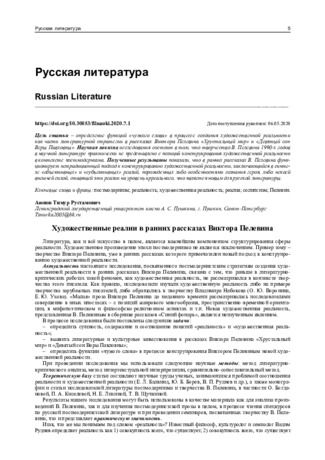
The purpose of the article is to identify the functions of the “alien word” in the process of creating artistic reality as a part of the literary strategy in Victor Pelevin’s stories “The Crystal World” and “Vera Pavlovna’s Ninth Dream”. Scientific novelty of the study lies in the fact that V. Pelevin’s creative work of the 1990s is barely represented in scientific literature from the perspective of constructing artistic reality in the context of postmodernism. The attained results have demonstrated that V. Pelevin’s early stories are within the unconventional approach to constructing artistic reality, which consists in the synthesis of “objective” and “subjective” realia attributable either to the specifics of a character’s consciousness or to some external force placing these realia at the level of irreality, which is new to the Russian literature.
-
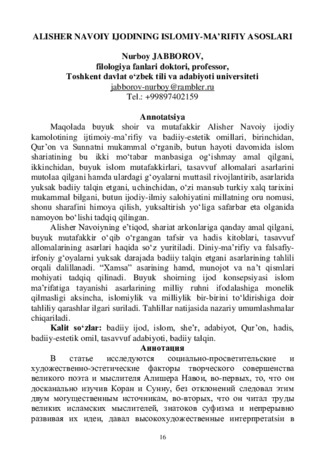
The article examines the socio-educational and artistic-aesthetic factors of the creative perfection of the great poet and thinker Alisher Navoi, firstly, the fact that he thoroughly studied the Koran and the Sunnah, followed these two powerful sources without deviations, and secondly, that he read the works great Islamic thinkers, experts in Sufism and continuously developing their ideas, gave highly artistic interpretations in his works, thirdly, that he perfectly knew the history of the Turkish people to whom he belonged, and that he was able to mobilize all his creative and scientific potential to protect and elevation of the honor and glory of the nation.
It discusses how Alisher Navoi followed the principles of faith and Sharia, tafsirs and hadiths read by the great thinker, the works of Sufism scholars. His artistic interpretation of religious-enlightenment and philosophical-mystical ideas at a high level is confirmed by the analysis of his work. The essence of the parts of "Hamsa" is being investigated, such as "hamd" (praise of Allah), "munajat" (request to Allah) and "nat" (praise of the prophet). Analytical views are put forward on the complementarity of Islamism and nationalism, the support of the concept of the great poet's work on Islamic enlightenment, which did not prevent his works from expressing the national spirit. As a result of the analysis, theoretical generalizations are made. -
In this monograph, the qualities of the great poet and thinker Alisher Navoi as a person and statesman, creative activity are highlighted based on new interpretations. Specific scientific views related to the mystical and literary-aesthetic world of our great-grandfathers have been put forward. Scientific-theoretical opinions are expressed in the Great Five - "Khamsa" regarding the artistic concept of the creator, the poetic interpretation of the image of the mother. The influence of Alisher Navoi's art on the improvement of the nation's literary and aesthetic thinking has been studied.
The monograph is intended for literary and narcissistic scholars, young researchers and general readers. -
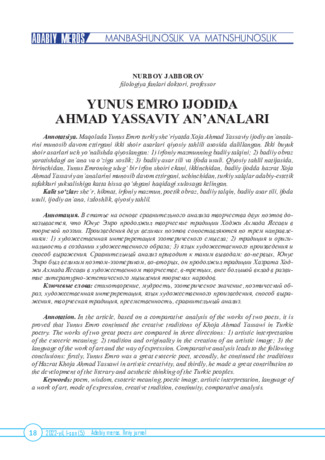
In the article, based on a comparative analysis of the works of two poets, it is proved that Yunus Emro continued the creative traditions of Khoja Ahmad Yassawi in Turkic poetry. The works of two great poets are compared in three directions: 1) artistic interpretation of the esoteric meaning; 2) tradition and originality in the creation of an artistic image; 3) the language of the work of art and the way of expression. Comparative analysis leads to the following conclusions: firstly, Yunus Emro was a great esoteric poet, secondly, he continued the traditions of Hazrat Khoja Ahmad Yassawi in artistic creativity, and thirdly, he made a great contribution to the development of the literary and aesthetic thinking of the Turkic peoples.
-
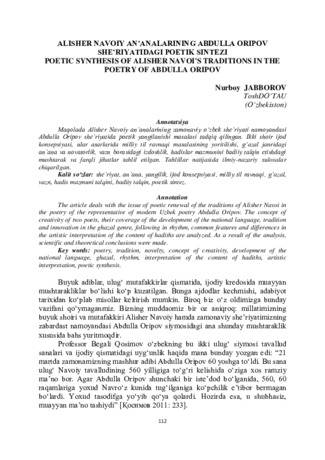
The article deals with the issue of poetic renewal of the traditions of Alisher Navoi in the poetry of the representative of modern Uzbek poetry Abdulla Oripov. The concept of creativity of two poets, their coverage of the development of the national language, tradition and innovation in the ghazal genre, following in rhythm, common features and differences in the artistic interpretation of the content of hadiths are analyzed. As a result of the analysis, scientific and theoretical conclusions were made.
-

The article analyzes the details of the deaths of the heroes of the epics "Farhod and Shirin" and "Layli and Majnun" in Alisher Navoi's "Khamsa". In the epics, heroesFarhod and Shirin, the cause of death of Layli and Majnun are explained. It has also been proven that many students' misconceptions that "these heroes killed themselves" are wrong, and that the suicide of these heroes is completely contrary to Navoi's moral and religious views. The fact that the deaths of these heroes took place quite naturally, by themselves, without revealing any cause, is shown by the examples taken from the epics. It is said that even in the most desperate moments of one's life, one should not commit suicide, but accept one's destiny and pray to the Creator in accordance with the etiquette of prayer.
-
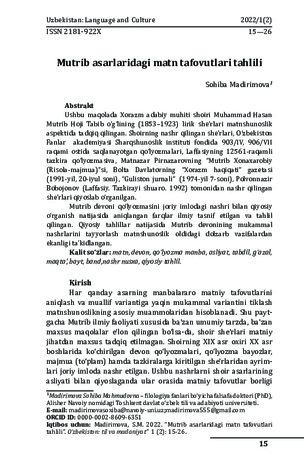
In this article, the lyrical poems of the poet of the Khorezm literary environment Muhammad Hasan Mutrib Haji Tabib’s son (1853 - 1923) are studied from the textual point of view. Published poems of the poet whichare kept in the fund of the Institute of Oriental Studies of the Academy of Sciences of Uzbekistan , manuscripts under the numbers 903/IV, 906/VII, manuscript number 12561 by Laffasi and Matnazar Pirnazarov's “Mutrib Khonakharobi (Risola complex)”, Bolta Davlatov's poems published by “Khorezm Haqiqati” newspaper (July 20, 1991), Gulistan Magazine (July 7, 1974), poems published by Polvonnazir Bobojonov (Laffasiy. Tazkirayi shuaro. 1992) were studied comparatively.
The differences identified by a comparative study of the Mutrib devoni manuscript with the current spelling edition were scientifically classified and analyzed. Relative analysis has shown that the making of excellent editions of Mutrib's devon is one of the most important tasks in the field of textology. -
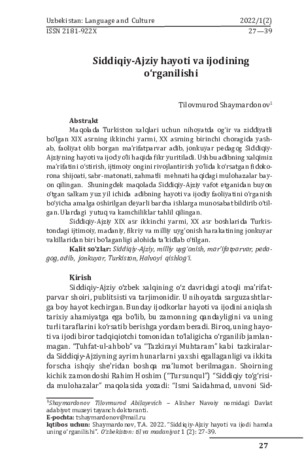
The article discusses the life and career of Siddiqi Ajzi, an enlightened writer and educator who lived and worked in the second half of the 19th century and the first quarter of the 20th century, which was extremely difficult and controversial for the peoples of Turkestan. Comments on the selflessness, perseverance and hard work of this writer in the development of the enlightenment of our people, the development of social consciousness. The article also comments on almost all the work done in the nearly one hundred years since Siddiqi-Ajzi's death to study the writer's life and work. Their strengths and weaknesses are analyzed. Siddiqui-Ajzi was one of the most active representatives of the social, cultural, intellectual and national revival movement in Turkestan in the second half of the 19th century and the beginning of the 20th century.
