Vol. 4 No. 2/S (2023)
05.00.00 - TECHNICAL SCIENCES

Digital publishing: how technology is changing the way we read and listen to books
Currently, more and more people prefer to use digital platforms for reading books and listening to audiobooks instead of traditional print publications. According to marketing research data, the number of users using digital books is constantly growing, and it is expected that in 2021 there will be about 1.08 billion digital book users worldwide. This may be due to the convenience of using digital platforms, which allow you to download and read books anywhere at any time. In addition, digital books often cost less than their print counterparts. Additional advantages of digital books include the ability to change font size, adjust lighting and background color, and search through text. These features can make reading more convenient for people with limited vision or in low-light conditions. Audiobooks are also becoming increasingly popular, with around 55 million people in the US listening to audiobooks in 2020. Additionally, many smartphone and tablet users use voice assistants to listen to audiobooks. This creates new opportunities for authors and publishers to expand their audience and increase profits. Overall, these trends in the digital publishing market indicate that the use of digital books and audiobooks will continue to grow in the future. This creates new opportunities for authors and publishers to adapt to changing reader needs and preferences.
07.00.00 - HISTORICAL SCIENCES

From the history of branch and district newspapers of the Fergana Valley
The article examines the history of branch and district newspapers in the Fergana Valley of the 50-80-ies of the twentieth century. As a research task, the author determined an attempt to evaluate the reflection of the socio-political life of society in the branch and district newspapers of the valley. Considerable attention is also paid to the activities of photojournalists in district and branch newspapers.

Transformations of social activity of the Sogdians on the Great Silk Road: from trade to diplomacy
The article deals with the active work of the Sogdians on the Great Silk Road. The author explores the role of the Sogdians as diplomats and traders and also tries to assess their influence on the life of the Turkic and Chinese ethnic groups. Particular attention is paid to the transformation of the social activity of the Sogdians throughout the history of the Silk Road.

Impact of the new economic policy on the activity of religious educational institutions (on the example of the kishlaks of the Fergana valley)
By the end of the 20s of the ХХ century, drastic measures were taken in the republic to eliminate old schools and madrasahs. Their activities were sharply criticized and rated as "remnants of the old way of life." In Uzbekistan, under the pressure of the Soviet authorities, measures were taken to prevent the reformation of old-style schools, and lose the reformed ones by opening new Soviet schools.

Agricultural policy of the soviet government in Turkiston villages in the first quarter of the XX century (on the example of the Fergana valley)
The article substantiates that the first quarter of the twentieth century was a period full of contradictory and complex realities for the population, the processes of struggle, the influence of the agrarian policy of the Soviet state on the agriculture of the Fergana Valley.
The traditional communal way of life of women in the Ferghana Valley in the late 19th - early 20th centuries
The article describes the role of women in public life of the Ferghana Valley in the late XIX - early XX centuries. The discussion of this issue in Turkestan was one of the important, but debatable. Despite the different opinions of researchers of different periods, the raising of this kind of problem in the period under discussion is the result of progress among the population of cities, especially villages.

Political system of the fourth Republic in France and its crisis
France was defeated in World War II. The resistance movement that began after this ended in 1944 with the liberation of France. The IV Republic, established in 1946, was a parliamentary republic. In the post-war period, France needed a management system that ensured the stable development of the country. The government, formed from representatives of the left and right parties, could not ensure stability. This circumstance and difficulties in foreign policy in 1958 led to the end of the period of the IV Republic.
09.00.00 - PHILOSOPHICAL SCIENCES

The content and structural elements of the concept of “human cultural level”
This article analyzes scientific approaches to the content and structural elements of the cultural level of a person and the concept of cultural level. It has been philosophically analyzed that the level of awareness of national and universal human values, the standard of knowledge of humanistic ideas formed by mankind over the centuries, and the level of mastering social and professional knowledge are included in the set of structural elements of the cultural level of a person.

The influence of ancient east religious and philosophical teachings on the doctrine of Sufism (in the example of the Zoroastrian religion)
This article reveals that religions and philosophies that have arisen in the history of mankind and which, although not called "Sufism", contain ideas and beliefs similar to Sufism and mysticism. After all, it has been proven that mystical tones are the philosophical views of each religious teaching, and the answer is given to the question of why it is necessary to look for the influence of various religious teachings from Sufism. The commonality is implied in the fact that there is a commonality between the holy books - the Torah, the Psalms, the Injil and the Holy Quran. But different sects, schools of thought and philosophical currents within religions are created by people, imitation, repetition and experience are in things created by people. Therefore, it was concluded that the commonality and similarity of the philosophical and mystical schools that arose at different times and in different places, in the structure of different religious teachings, is not an anomalous or accidental phenomenon. It is explained that all philosophical and gnostic teachings can be a source of each other, influence each other or enrich each other.
12.00.00 - LEGAL SCIENCES

Certain aspects of sentencing for crimes for which a plea agreement was concluded in the criminal law of the Republic of Uzbekistan
In recent years, one of the things done to democratize and liberalize the judicial system in our country was the addition of Article 572 to the Criminal Code. The conclusion of an agreement on the admission of guilt and the imposition of punishment in cases where an agreement has been concluded are reflected in the criminal legislation of many countries. The article focuses on the order of sentencing for crimes for which a plea agreement was concluded and its special features.

Legal mechanism for regulation of trade relations of the Republic оf Uzbekistan within the framework of joining the world trade organization
This scientific article notes the formation of the state as a full-fledged participant in international trade relations, the development of partnership trade relations, as well as joining leading international trade organizations to enter the international market. This paper also discusses the identification of possible problems and prospects for the membership of the Republic of Uzbekistan in the World Trade Organization, the characteristics of the socio-economic situation of the country, the prospects for the development of the current state of the country, the assessment of the foreign economic activity of the state, the benefits and risks for the Republic of Uzbekistan when joining the WTO.

Scientific theoretical and legal analysis of increasing the role of political parties in the activities of the representative body of state power
It is important to strengthen the positions of political parties and expand the scope of their activities in parliamentary activities. The reason, first of all, is that the majority of deputies are candidates represented by political parties. At the same time, the factions of the state representative body also work in accordance with the interests of their electorate and their needs and requests, which allows them to develop pro-people legislative projects and implement them. It should be noted that listening to the requirements and wishes of the population and an adequate response and joint solution to a number of problems in the social sphere with the population will change the attitude towards the activities of political parties and their factions in parliament for the better. This article provides to increase the role of political parties in the socio-political life of the parliament, by analyzing their essence in conjunction with domestic and foreign practices, to identify problems and make specific proposals on them.
Investment funds: SICAV or joint-stock company
The article analyzes the possibilities of the normative legal framework for organizing the activity of investment funds in Uzbekistan and legal approaches in this regard. Although there have been views on the need to use the opportunities of investment funds in Uzbekistan for a long time, no progress has been observed in terms of legislation. At a time when there are almost no changes in the legislation, interest in investment funds is growing among the population. According to the author, the current national legislation does not provide an opportunity for the establishment of investment funds and their effective operation. The Law of the Republic of Uzbekistan "On Investment and Mutual Funds" deals only with general aspects of investment funds. However, this law could not regulate important issues for investment funds. The law refers all issues regarding the organizational and legal form of the investment fund to the Law of the Republic of Uzbekistan "On the Protection of the Rights of Joint-Stock Company and Shareholders". The Law "On the protection of joint-stock company and shareholders' rights" did not take into account the peculiarities of investment funds. In particular, the law on joint-stock companies establishes difficult procedures for share buybacks. In the concluding part of the article, it is noted that in the legal systems developed by the author, there are specialized types of joint-stock companies for investment funds, they reflect the peculiarities of investment funds and are very convenient for investors, and proposals for improving national legislation are put forward.

The principle of good faith in a loan agreement
The article analyzes the issues of reasonableness and good faith on the part of participants in credit relations, the problems of usury and its consequences, the concept of good faith and its place in a loan agreement. The author cites court cases in which the bank acted as an unscrupulous party that unilaterally changed the terms of the contract that were essential for the borrower. In addition, issues of bad faith on the part of the borrower are also being studied.

Measures to prevent terrorist acts using vehicles in world practice
The article examines in detail the legal and organizational measures taken to prevent transport terrorism in some foreign countries where terrorist acts using vehicles are relatively popular, such as the USA, Great Britain, Spain, Germany, France, and Sweden. Targeted measures that give positive results in prevention are analyzed.

Acquittal in criminal proceedings: theoretical foundations and law enforcement practice
The article analyzes the legal nature of an acquittal in the Republic of Uzbekistan. The author also concluded that an acquittal is a procedural act of judicial law enforcement, fixing, because of a legal assessment of the objective and subjective facts of reality underlying it, the unestablished guilt or established innocence of the accused, which is the basis for the application of the rules on rehabilitation. This definition determines the development of general theoretical ideas about the essence of an acquittal and its significance for law enforcement practice. The most important feature of an acquittal is validity. An acquittal should be considered justified in the case when the circumstance determining the resolution of the criminal case - the failure to prove the indictment - corresponds to the actual circumstances, i.e. the realities of the law enforcement process. An acquittal is an act by which the state, represented by the law enforcement system, refuses to prosecute a person and recognizes the groundlessness of the charges against him. As a legal document, an acquittal is the basis for applying rehabilitation measures to the acquitted person, and from a social point of view, it indicates the restoration of the reputation of a person whose rights have been illegally violated.

Historical stages in international legal assistance
This article discusses the historical and modern forms of international cooperation in the field of criminal court cases, the legal basis for cooperation, legal relations related to the provision of legal assistance in criminal cases, and norms of multilateral international conventions on combating international crimes. or special agreements on legal cooperation, international crimes, and international conventions governing and arrest rules for criminals are described.

Overcoming conflicts of interest in education: effective practices and solutions
The sphere of education is a key link in the system of the normal functioning of the state, for this reason, it is particularly vulnerable to various types of threats. In this regard, it is clear that it is necessary to pay special attention to the prevention of corruption offenses in the educational process. Particular attention is paid to the conflict of interests. This article describes all the negative consequences that can occur due to a conflict of interests between subjects in the field of education and also describe methods for solving and preventing this problem. The opinions of scientists who have studied and considered this problem as a consequence of the lack of clear and strict rules and policies in the field of conflict of interest management at universities or who believe that the root of the problem lies in the culture of corruption and lack of professional ethics among teachers and managers in education. In the conclusions, the author proposed, in addition to improving the level of professionalism and ethics in the management of educational institutions, to supplement the Uzbek legislation about education with a new definition of the conflict of interests of a teacher.

The language of criminal proceedings in the legislation of the Republic of Uzbekistan
In the article, the concept and essence of the language used in criminal proceedings in the process of criminal cases, the role of Uzbek language as the state language in the life of our country, the mother tongue and language-related rules contained in normative legal documents and international documents, nationality, issues related to ensuring the rights of those citizens participating in criminal proceedings who do not know the language of the proceedings or those who do not understand on the required level were scientifically analyzed and appropriate proposals were put forward in this regard.

Вопрос действии закона во времени исторически развивался как вопрос обратной силы или обратного действия и имеет долгую историю. При смягчающих обстоятельствах обратная сила закона применялась не только в древних Афинах, но и в Древнем Египте. Принцип отсутствия обратной силы впервые был четко сформулирован в римском праве, а к концу II века до н.э. уже применялся в уголовном и гражданском праве для защиты существующего правопорядка и экономических интересов. Основным принципом римского права являлось признание силы права только на будущее, причем к ранее возникшим юридическим фактам и отношениям необходимо применять прежние нормы, т.е. «leges et constitutionis futuris certum est dare formam negotiis, non ad facta praeteria revocari». В Средние века считалось, что преступники не имеют права требовать применения к ним тех или иных законов. Хотя принцип законности был разработан как идея в эпоху Просвещения, в начале XIX века именно Фейербах преобразовал его из идеи в многоаспектный принцип, создал особое правовое учение. Со временем идеи и взгляды о действии уголовного закона во времени стали закрепляться в качестве норм в декларациях, конституциях и уголовных законах.
The issue of the operation of the law in time has historically developed as an issue of retroactive force or retroactive action and has a long history. Under mitigating circumstances, the retroactive force of the law was applied not only in ancient Athens, but also in ancient Egypt. The principle of non-retroactivity was first clearly formulated in Roman law, and by the end of the II century BC it was already applied in criminal and civil law to protect the existing legal order and economic interests. The basic principle of Roman law was the recognition of the power of the law only for the future, and the former norms must be applied to previously arisen legal facts and relations, i.e. "leges et constitutionis futuris certum est dare formam negotiis, non ad facta praeteria revocari". In the Middle Ages, it was believed that criminals did not have the right to demand the application of certain laws to them. Although the principle of legality was developed as an idea in the age of Enlightenment, at the beginning of the XIX century it was Feuerbach who transformed it from an idea into a multidimensional principle, created a special legal doctrine. Over time, ideas and views about the operation of the criminal law in time began to be fixed as norms in declarations, constitutions and criminal laws.

Improving the organizational and legal foundations of relations between the state and advocacy
This article presents a scientific and theoretical analysis of the issues of ensuring the organizational independence of the institution of the bar, and scientifically substantiates that independence is a prerequisite for the existence of the bar. The principles and guarantees of the institution of advocacy are also highlighted. Scientific, theoretical and practical proposals have been developed on the role of the institution of advocacy in the life of the state and society, considering this institution an integral part of the judicial and legal system. Suggestions on improving the legal framework of the institute of advocacy are given.

Foreign and national experience in a predicate crime setting
This article analyzed issues related to the identification and definition of predicate crimes, which are considered as the main crime in the commission of crimes related to the legalization of proceeds from criminal activity. Also, the article analyzes the international conventions that should be taken into account by the countries when defining the predicate crime, and the definition that is suitable for the legislation of Uzbekistan was developed.

The history of the development of processes for simplifying proceedings
Analyzing the history of the origin of the consideration of criminal cases in our country in a simplified manner, the stages of the formation of these processes are studied and analyzed suggestions and recommendations are given to the Criminal Procedure Code adopted in the new edition on certain types of proceedings of a simplified form.

Improvement of legal regulation of dividend payments in the Republic of Uzbekistan
This article examines the theoretical and practical issues of legal regulation of the payment of dividends in joint-stock companies, various models, and features of the dividend policy, as well as the main directions for improving the legal regulation of decision-making and the payment of dividends by types of shares. In addition, the article analyses the topical problems of legal regulation of the procedure for paying dividends in joint-stock companies and ways to improve them based on national and best practices in foreign countries.

Crime prevention issues in public procurement
In the article discusses the current situation regarding the legal regulation of the detection and prevention of violations related to public procurement, as well as the measures implemented in the republic in this area, topical issues related to the implementation of these measures. In addition, the experience of Germany and the European Union was briefly studied, and on its basis conclusions and proposals were made to improve the system for combating corruption crimes in the field of public procurement.

Comparative analysis of appointing and conducting forensic examinations in criminal proceedings in some CIS countries
The development of modern ideas about forensic expertise in domestic criminal justice and some CIS countries is being studied. In the article, taking into consideration the comparative legal analysis of the legislation of some CIS countries' regulation of forensic examination, the features of the national approaches to this activity are revealed.

Procedural grounds for conducting a search and investigative action
This article discusses the factual and legal grounds for conducting the investigative action of the search, its content, and the opinions of scientists who conducted research on this issue. The purpose of the search at the stage of pre-trial proceedings in the case and its legal consequences are considered. The article also provides a detailed analysis of the sentence “wanted person”, provided for in Article 158 of the CPC, in accordance with Articles 55 and 66 of the CPC. It is indicated that, although the witness is obliged to be present when summoned by the investigator, granting him the status of a “wanted person” makes it impossible to conduct a search investigative action in his home in order to find him. The necessity of establishing sufficiently stringent requirements for the actual grounds for conducting a search is substantiated, taking into account the fact that a search is a serious interference in the private life of citizens, closely related to the restriction of their constitutional rights. It is noted that the conduct of a search is mandatory and requires taking into account the high significance of this investigative action.

Legal regulation of the advocate's activity and improving the status of the advocate in the Republic of Uzbekistan
The article considers the legal norms which regulate the activities of the advocacy institution, international legal acts, ratified and adopted by Uzbekistan, as well as further actions to reform the institution of the advocacy, improve the status of the advocate, turn the advocacy into a real institution of civil society.

Issues of application of prejudice in the criminal-procedural legislation of certain CIS states
The tasks of the research are aimed at the implementation of the set goal. In the article the binding nature of court documents in criminal proceedings from a scientific and theoretical point of view was analyzed, the concept of prejudice in criminal procedural law and the history of the development of this institution were studied, the prejudicial importance of legally binding court decisions was determined, prejudice in court proceedings the necessary conditions of application were clarified. The experience of foreign countries was studied by researching the subject and scope of evidence in court proceedings.
Legal nature of civil society institutions: scientific and theoretical analysis
The reforms being carried out in the country are based on supporting civil society institutions, ensuring the well-being of society by expanding the scope of their activities, promoting civic engagement, national self-awareness, political culture and high spirituality of society members, their self-respect, independent thinking, aimed at creating a desire to realize their potential, build your future of your own free will. Although the concept of civil society institutions is presented in the scientific literature, the legal status of this institution is not specified in the legal documents. The article analyzes the organizational and legal forms of a number of civil society institutions, the opinions of scientists and current norms of national legislation. An attempt was also made to highlight the limits of the activity of civil society institutions and public administration. In this study, foreign literature and legal systems of foreign countries were used to achieve the purpose of the article.

Features of the definition of the attorney – client privilege in US judicial practice
In this article, the author, on the basis of comparative analysis, studied various approaches and doctrines for determining attorney-client privilege in the United States. In addition, the author gives the historical origin of the concept of attorney-client privilege. The judicial precedents related to the definition of the criteria for attorney-client privilege and its limits are analyzed. Based on the results of studying the features and criteria of attorney-client privilege, the author gives a universal definition of this concept.

The essence of an acquittal in criminal procedure law
The article analyzes the procedural grounds for justification, its structure and content. The author analyzes the problems of acquittals and the institution of rehabilitation of the acquitted. The grounds for an acquittal and their procedure are subject to scientific analysis. The main purpose of the research is to guarantee the rights of citizens by issuing acquittals, not to make illegal, unreasonable, unfair court decisions against innocent people, as well as to improve the quality of decisions made by the court, to investigate the problems that arise in connection with this.

General requirements of the admissibility of evidence obtained during the conduction of operational-search measures at the stage of pre-investigation verification
The article analyzes various aspects of processing the results and materials of operational-search activity (hereinafter referred to as ORA), in particular, definitions of ORA and operational-search activities (hereinafter ORM) are given and the meaning of these concepts is compared, a definition of pre-investigation checks, results and materials are given operational-search activity, the significance of the grounds and conditions necessary for conducting an ORA, the types, and classification of the ORA are indicated. Also in this article, a comparative study of various norms of the national criminal procedure legislation related to the use of evidence obtained through the conduct of the ORM was carried out. In addition, this article indicates scientific approaches to the possibilities of using evidence obtained as a result of the ORM, as well as ways to include materials obtained during the ORA in the evidence, the presence of general and special requirements for the admissibility of ORA materials is highlighted and indicated, and also listed and the general requirements for the admissibility of these materials are disclosed in detail.

Refusal to initiate criminal proceedings: problems of theory and practice
This article discusses the results of a comparative analysis of the criminal process of some foreign countries on pre-trial proceedings. Pre-trial investigation includes such forms as inquiry and preliminary investigation. For the purpose of a detailed analysis of this institute, the author has studied normative legal acts aimed at regulating law enforcement practice. Based on currently available scientific research on the forms of pre-trial investigation, the author conducts a comparative analysis of existing forms and models of pre-trial investigation.
13.00.00 - PEDAGOGICAL SCIENCES

Voice capabilities of the singer and her hygiene rules
This article provides detailed information about the reforms in our country, the attention paid to the art of music, in particular, the development of the art of singing, the singer’s voice, sounds, sound waves, and types of sound.

The study of syntagmatic relations in linguistics
The article deals with the syntagmatic aspect of the study of linguistic units in the history of linguistic teachings. Exploring the linear connections of words, the author traces the development and reveals the patterns of syntagmatic teaching, starting from the very first known works until the advent of the theory of compatibility.

Influence of national values on personal development
Values are the traditions and activities of every people that are ingrained in their blood. The place of these things is very important in the growth of every person. are special things.

Pedagogical competence of physical education teacher
This article deals with the problems of the development of the culture of greeting and preparing higher qualified sportsmen and the demands for a specialist in physical education.

Methods of implementing the Finland experience in establishing cooperation between preschool educational organizations and the family
This article focuses on the world-famous Finnish system of preschool education. The Finnish education system has been extensively tested over decades and has achieved impressive results. It combines the best and latest teaching philosophies, models, and practices with continuous development to meet the highest educational standards. This article presents thoughts and opinions on establishing cooperation between preschool education organizations and families, using the Finnish experience in introducing various innovations in educational processes.

Studying Finland education system in international research
This article provides detailed information about the possibilities of introducing the Finnish education system, communications in the Finnish education system, primary education, secondary education, textbooks in Finnish schools, the work of teachers, and the opportunities provided to students at school.
Formation of communicative competencies in student environment
Pedagogical dialogue is a special type of pedagogical relations built on the principles of cooperation, co-creation, mutual respect and mutual understanding, a specific form of communication involving not only information communication of subjects, but also their spiritual unity, a special form of pedagogical interaction aimed at solving the problem. The purpose of the study is to develop methodological recommendations on pedagogical communication of students based on the analysis of psychological and pedagogical research on the problem.

Methods and means of creating a comic effect of irony in discourse
Stylistic paths give the colorful meaning of the meaning of discourse; therefore they are usually used in literal text. One of them, is irony. Irony is a type of stylistic technique that will be investigated in this article. The purpose of the article is to find out some of its types. Moreover, some literary works, including irony, are illustrated.

The use of zoomorphisms as praise in Uzbek language culture
In this article, praise zoomorphisms and their stylistic features in Uzbek culture are analyzed and explained through examples. Human appearance and character traits are reflected through animal names and their characters are revealed.

General issues of nomination processes for creating goals and objectives for naming works of art
This article discusses general issues related to the nomination process of creating the names of works of art and an analysis of anthroponyms, words-analogs of the Uzbek language, and metaphors. Within the framework of linguoculturology, the semantic nature of the nomination process and its external structure and form are studied. The article also contains attempts to consider these issues in the context of the current linguistic interpretation, using the results of paremiological studies.

The role of Uzbek folk tales in child education
Today, one of the most important tasks of preschool education organizations are to educations is to educate preschool children with the rich national, cultural and historical heritage and spiritual and moral values of the people.

Effectiveness of variative development of educational programs in pedagogical processes
Diversity of education is one of the main principles and directions of modern education. The content of educational programs and the variability in their implementation mean that each educational institution, even each pedagogue, can create their own educational programs and use different methods of their implementation. The main condition of variability is that it should be developed in accordance with the main principles and requirements of the state curriculum, as well as the requirements of the state.

Increasing emotional stability in preschool children with the help of physical culture
The article analyzes mental development of preschoolers, the processes of their preparation for school, and difficulties encountered in adapting to educational activities.

Socio-pedagogical model of the formation of a system of values among children
In this article, a socio-pedagogical model of the formation of value orientations of children in orphanages in the process of continuous learning is developed. System, axiological, cultural-humanitarian, ecological, and personality-oriented approaches were taken as the basis for the formation of the system of values of foster caregivers.

The value of observation in environmental education of preschoolers
Today, we are observing various negative processes in nature as a result of the wrong use of nature by mankind. First of all, we need to raise the ecological culture of the young generation to prevent such situations. Preschool education organization is considered the primary unit of continuing education. That's why we need to form an environmental culture in the children of the preschool educational organization. One of the most effective ways to do this is observation. This article describes the role of the environment in the environmental education of children of a preschool educational organization and methods of developing children environmental culture.
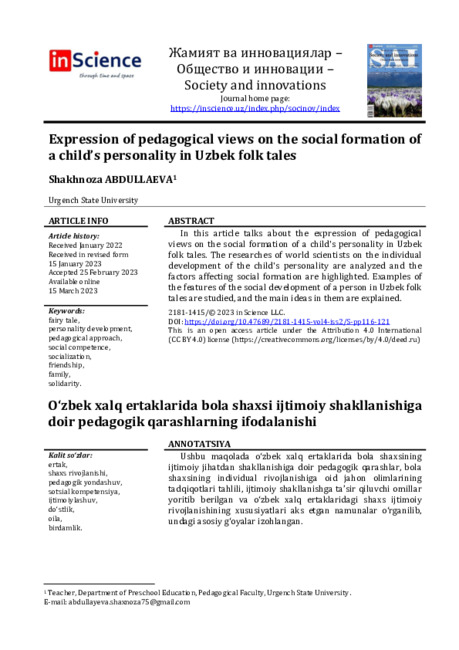
Expression of pedagogical views on the social formation of a child’s personality in Uzbek folk tales
In this article talks about the expression of pedagogical views on the social formation of a child's personality in Uzbek folk tales. The researches of world scientists on the individual development of the child's personality are analyzed and the factors affecting social formation are highlighted. Examples of the features of the social development of a person in Uzbek folk tales are studied, and the main ideas in them are explained.

Mathematical modeling of internal water consumption in drinking water preparation system
In determining the amount of water consumed by the population and industrial enterprises in the drinking water preparation system, the problem of mathematical modeling of the internal water consumption of the drinking water preparation station was studied.

Moral development in adolescent period as a subject of empirical research
The article focuses on the psychological features of the development of the moral sphere during adolescence. It also analyzes the research of scholars on the formation and development of the moral sphere in the individual, as well as the main mechanisms. In particular, research has been conducted to study the development of the field of ethics during adolescence, and a scientific-practical approach has been put forward in this regard.

The role of the game in developing creative activity in preschool children
In this article, the approaches to the concept of creativity, the role of the game in the development of creative activity in preschool children, and the possibilities of development based on the competence approach were analytically and comparatively described. It focuses on the development of preschool children's attitude to the game and activity based on the game.

The essence and content of immersive educational programs in teaching Russian as a foreign language
This article discusses the essence and content, as well as the effectiveness of using the latest technologies by means of immersive learning programs in teaching Russian as a foreign language in the educational process. The active introduction of these technologies in the classroom contributes to a significant increase in the level of thinking of students and leads to a positive change in the development of oral speech in Russian language classes.

Training future educators in the use of digital technologies
This article discusses information about teaching preschool children to expand memory, perception, imagination, free thinking, independently express their attitude to current events through the use of digital technologies in preschool educational organizations. The productive use of ICT in the process of activity in order to form the intellectual abilities of children is evidenced by the research work of a number of scientists

Characteristics оf the fоrmatiоn оf sоcial mоtives оf preschооl children
In this article, scientific views on the development of social motivation in children are considered based on the analysis of scientific research currently being carried out on the formation of behavior and social relations of preschool children.

Modern technologies of logical mathematical development and teaching of preschool children
Modern logical and mathematical games show the child's constant desire (to collect, link, connect, measure), cognitive initiative and creative abilities. They help to create a positive environment for the development of attention, memory, speech, imagination and thinking. Many modern games help children to act consistently and use symbols.
14.00.00 - MEDICAL SCIENCES

Stages of developing international standards and a quality management system
Quality is a set of characteristics and particular features of a product, material, type of work, labor, services, etc., which are justified by the satisfaction of human actions and requirements and are evaluated by their full compliance with the established requirements and their tasks. The ISO 9000 standard is interpreted in the form of "quality – the level of compliance with specific characteristic requirements". The quality of education determines the state and result of the educational process in society, as well as the formation and development of professional competence of the individual, in accordance with the requirements and needs of society. The quality of education has two aspects: compliance with state educational standards; compliance with consumer requirements.
19.00.00 - PSYCHOLOGICAL SCIENCES
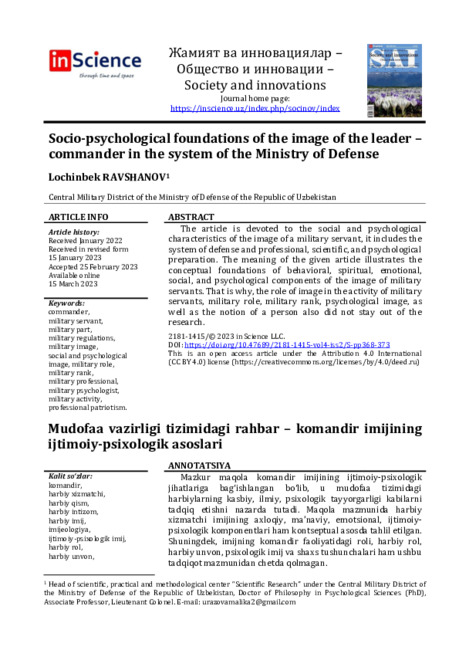
Socio-psychological foundations of the image of the leader – commander in the system of the Ministry of Defense
The article is devoted to the social and psychological characteristics of the image of a military servant, it includes the system of defense and professional, scientific, and psychological preparation. The meaning of the given article illustrates the conceptual foundations of behavioral, spiritual, emotional, social, and psychological components of the image of military servants. That is why, the role of image in the activity of military servants, military role, military rank, psychological image, as well as the notion of a person also did not stay out of the research.

Theoretical basis youth marginalization
This article analyzes the processes of marginalization of young people in the social structure and the processes of the emergence of marginal strata and statuses. The author describes and justifies the state of marginal status in the social structure of the modern community.
22.00.00 - SOCIOLOGICAL SCIENCES
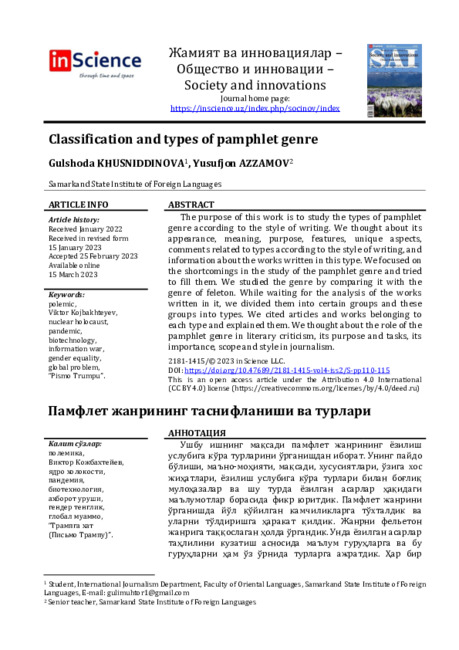
Classification and types of pamphlet genre
The purpose of this work is to study the types of pamphlet genre according to the style of writing. We thought about its appearance, meaning, purpose, features, unique aspects, comments related to types according to the style of writing, and information about the works written in this type. We focused on the shortcomings in the study of the pamphlet genre and tried to fill them. We studied the genre by comparing it with the genre of feleton. While waiting for the analysis of the works written in it, we divided them into certain groups and these groups into types. We cited articles and works belonging to each type and explained them. We thought about the role of the pamphlet genre in literary criticism, its purpose and tasks, its importance, scope and style in journalism.

Dissemination of false information in eco-journalism and its solutions, problems, and solutions in the field of ecology in our country
In this scientific article, a special field of journalism in the field of eco-journalism, disseminating false information, keeping it, publishing information without verification, laws in the field of eco-journalism, solutions for the restoration of the environment in our country, the restoration of nature in the online ecological community, the violation of the ecology distributed on various sites and social networks, and the legal solution of illegal information are considered. Also, while reading the article, you will see that various punishments are imposed for spreading false information, how important environmental audit is in the violation of ecology, that there is a legal punishment for false information given on the Internet, and also that there are many programs related to ecology in our country.

