Vol. 2 No. 2 (2024)
Articles

General theoretical foundations of legal speech
A lawyer’s professional speech is the basis of his business competence. Legal practice contributes to the emergence of conditions that require appropriate solutions in the process of interpersonal interaction, therefore the development of speech among lawyers is a necessary condition for the development of professional skills. However, there is often a need for recommendations on improving a lawyer’s speech, editing dialogue, and conducting a conversation. This article examines the features of a lawyer’s professional speech from a legal and linguistic point of view.

The role of neuro-linguistic research for linguistics and methods of teaching foreign languages in the formation of speech communication
This article examines the role of neurolinguistic research in linguistics and methods of teaching foreign languages in the formation of verbal communication. The use of knowledge of neuropsychology, psycho-, and neurolinguistics in pedagogy makes it possible to most effectively develop new teaching methods. As for learning a foreign language, it is quite obvious that the time required to achieve the same result is reduced, in contrast to traditional teaching methods, by at least ten times. Every specialist who needs to learn a foreign language can do this without interruption from their main activity in the shortest possible time and to the required extent, especially in the development and formation of verbal communication.

The impact of reflection on developing students' problem-solving skills in Chemistry
This article analyzes the possibility of using a reflective approach to developing students' problem-solving skills in chemistry. It is based on the mechanism of developing students’ problem-solving skills and the importance of using a reflective approach to their mastery.

Encouragement from parents of educated, capable and talented students
This article examines the impact of parental support on the success of educated, capable and talented students, as well as ways to increase students' interest in learning. The study showed that students who receive support from their parents are more likely to demonstrate high results. Collaboration between parents and teachers improves students' educational achievements. The article also analyzes changes in students' behavior that were stimulated by parental attention, including their attitude towards learning and interaction with others.

Display of politeness as an ethnocultural communicative category in the English language
In this article, politeness is considered as an ethnocultural communicative category. A speech act aimed at achieving specific communicative goals is used as a strategic tool for solving general communicative problems. The success and effectiveness of intercultural cooperation depend not only on knowledge of the language, but also on an understanding of the culture, traditions, values and customs of the people. This article emphasizes that a deep understanding of the worldviews of speakers of other languages is also a key factor in successful intercultural communication.

The role of the directions of the paradigm of the anthropocentrism in modern linguistics
The research investigates the multifaceted role of anthropocentrism within contemporary linguistics, spanning various dimensions of language study. Beginning with an exploration of anthropocentrism's definition and background, it delves into its relevance across linguistic subfields. Under human exceptionalism, it scrutinizes linguistic structuralism's implications and the universality posited by universal grammar theories. Moreover, it scrutinizes language acquisition theories, unraveling anthropocentrism's underpinnings in cognitive linguistics. Expanding beyond traditional paradigms, the study embraces ecological linguistics, examining language within ecological contexts. It dissects how language interacts within ecosystems, delving into linguistic relativity and cultural ecology, along with sociolinguistics' role in understanding language variation.
Furthermore, the research navigates through the implications of anthropocentric directions within modern linguistics. It scrutinizes methodological approaches, ethical considerations, and the crucial need for linguistic diversity in research practices. Addressing future trajectories, it elucidates potential challenges and navigational routes for linguistic inquiry. Case studies presented underscore the practical applications of anthropocentric paradigms, elucidating their significance in preserving endangered languages, navigating human-machine interaction, and understanding urban linguistic landscapes.
In conclusion, the research synthesizes its findings, highlighting the intricate roles anthropocentrism plays across linguistic domains. It reflects on the dynamic nature of anthropocentrism in shaping linguistic inquiry and suggests avenues for future research. By unraveling the multifaceted dimensions of anthropocentrism, the study enriches contemporary linguistic discourse and provides insights into the complex interplay between language, culture, and society.

The scientific basis of eliminating stress in the process of reading comprehension in future German teachers
This article describes evidence-based methodological recommendations for future teachers of the German language, aimed at improving reading comprehension skills and relieving stress in the process of reading and comprehension, as well as optimal time management, taking advantage of visual materials and various types of texts in organizing a lesson.
Linguistics and intercultural communication

The history of sentence structure and study
In this work, the main goal is to study the features and patterns of constructing sentences in English and Uzbek languages, identifying their similarities and differences, as well as their comparative analysis from a cognitive-grammatical point of view. One of the key aspects of studying the syntactic-semantic and structural organization of languages is conducting a comparative analysis. In such a study, it is necessary to determine the structural and semantic features of sentences using examples of related and unrelated languages.

Analysis of authentic speeches (conversation analysis) and electronic language corpora as methods of gathering information within the framework of the lingua-pragmatic approach
The article analyzes the theory of language within the framework of functional linguistics and the linguapragmatic approach. This approach involves the creation of multiple sources for collecting reliable information, focused on developing lessons taking into account the specific communicative situation, as well as different social contexts and cultures. Among the methods of data collection, the analysis of authentic speech (conversational analysis) and the use of electronic language corpora stand out.

The role of prepositions in constructing meaningful context in English: secrets of grammatical success
This article discusses the importance of teaching prepositions in the process of learning the English language. Through the analysis of various sources and pedagogical experience, the significance of correct preposition usage is emphasized for forming grammatical accuracy, coherence of expression, and understanding of context. The article explores teaching strategies aimed at the effective acquisition of prepositions, including the use of exercises, games, and contextual learning.

Categorial features of aspectuality in English and Uzbek languages
In the course of our study, we paid special attention to the category of aspectuality and, first of all, tried to determine whether there is a morphological category of verb types in English and Uzbek. In the study of verb meaning, the intended goal can be achieved only by addressing not only grammatically formed categorical units, but also all linguistic means expressing aspectuality. This is why specific theories and approaches of aspectuality have emerged, based on the composition of a particular language.
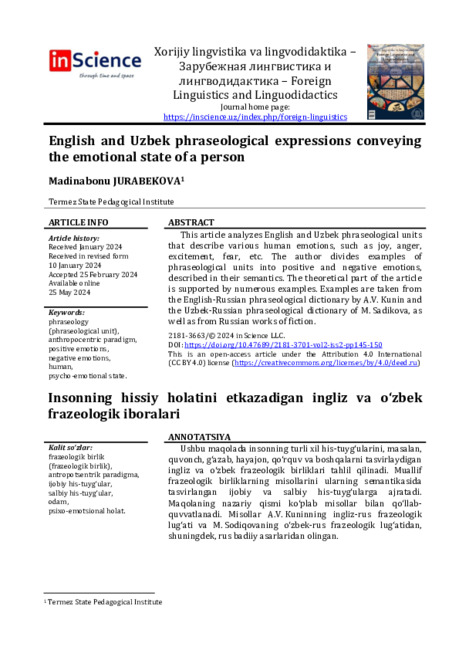
English and Uzbek phraseological expressions conveying the emotional state of a person
This article analyzes English and Uzbek phraseological units that describe various human emotions, such as joy, anger, excitement, fear, etc. The author divides examples of phraseological units into positive and negative emotions, described in their semantics. The theoretical part of the article is supported by numerous examples. Examples are taken from the English-Russian phraseological dictionary by A.V. Kunin and the Uzbek-Russian phraseological dictionary of M. Sadikova, as well as from Russian works of fiction.

Use of toponyms in modern French media
The article deals with the role of toponyms in the media in France and the figure of speech used in media texts to influence the reader or listener. The official and unofficial toponyms are considered

Meronymic phenomena between English and Uzbek languages
This article discusses lexical phenomena, particularly, meronimic relations, which are one of the new word meaning relations with their semantic field in Linguistics. It is based on, particularly, semantic and lexical, pragmatic features as well as the relationship of comparative analysis in two languages Uzbek and English. A practical analysis of the mutual expressions of meronymic words in two languages and their differentiation and separation, that is, whether the meronymic features of these two languages are equal or unequal, are provided. Furthermore, it is explained that words related to meronymy, express the linguistic and non-linguistic appearance of words between the two languages, determining mutual relations in semantic meanings and stylistic colors from different points of view.

On the use of English borrowings in Uzbek political discourse
This article focuses on the context and semantic aspects of the use of English loanwords used in Uzbek political discourse. Each English political term is explained with the help of examples. Special consideration is given to the contexts of use, historical etymology, and ethnolinguistic aspects of such loanwords as holocaust, caucus marathon, and primaries in English political discourse.

Types of cognitive models of polysemy of linguistic terms
This article explores cognitive models of polysemy, revealing how multiple meanings of linguistic terms are structured and understood. Through radial categorization and metaphorical extension, it underscores the complexity of language and cognition.

The role of the concept in modern linguistics (on the example of the concept of death)
This scientific article reflects the role and importance of the concept in linguistics, its interpretation in people's lives, and how the concept of death is reflected in Muslim countries in connection with the concept. The reflection of the concept of death in the English and Uzbek culture in Islam and the deeds of the holy book of the Quran.

Ethnolinguistics and its theoretical foundations
This article analyzes the science of ethnolinguistics and its theoretical foundations. The importance of studying the connections between ethnolinguistics and linguistics, their interdependence, and the relationship between culture and language is shown.

Development stages of terminology in Linguistics
This article presents information about the stages of development of terminology as a branch, based on the development of a specialized conceptual apparatus of various disciplines. The main tool for structuring and systematizing this conceptual apparatus is a special terminological dictionary, which represents a central element in the study of terminology. The article emphasizes that in the modern scientific and linguistic context the role of terminology is constantly increasing, but the development of terminography does not always keep pace with the rapid progress of various scientific fields, which jeopardizes the adequacy and relevance of terminological databases.

The problems of categorization in comparative linguistics
This article discusses interference phenomena in comparative linguistics, examining their impact on language acquisition, communication, and language relationships. It explores the mechanisms of interference, proposes solutions, and highlights implications for comparative linguistics. The study of interference helps identify challenges in pronunciation, grammar, vocabulary, and discourse patterns. It also contributes to understanding language contact, preservation efforts, and language typology. Ongoing research and collaboration are crucial in addressing interference challenges in language learning.

Exploring the lexical variations in color semantics: a comparative analysis
This article delves into the intricate field of color semantics, focusing on the lexical variations and their comparative analysis across English, Uzbek, and Russian languages. It emphasizes the significance of the linguistic worldview in understanding national mentalities and how color terms contribute to this process. The study aims to compare the color-naming lexicon in these languages, identifying structural and semantic similarities and differences. The importance of this research lies in its interdisciplinary approach, combining comparative linguistics and linguocultural studies, offering fresh perspectives on issues related to color terminology. The subject matter includes a group of color-naming terms, exploring their role in daily life, expressiveness, and reflection of a nation’s spiritual and material culture. The goal is to enhance our comprehension of color lexicon’s contribution to knowledge and achievements within the human experience, mediated through language.

Description of terminology for the army and its units in historical texts
The history of all class societies is filled with stories of wars, invasions, and robberies between states, which is especially clearly demonstrated by the example of the centuries-old history of the peoples of Central Asia. Several written sources reflect the bloody conflicts of the peoples of Central Asia, including Uzbek, Tajik, Turkmen, Kyrgyz, Karakalpak, and others. Most of these sources, created in the 19th century, contain many words and terms related to military affairs and its various aspects. In this article, we will briefly look at their history and significance.

Main types of Russian linguistic dictionaries
The Russian language has a long and rich history, with its own unique vocabulary, grammar and style of expression. As with any developed language, Russian lexicography has created numerous dictionaries over the centuries to document and define the language. There are several main types of linguistic dictionaries created for the Russian language, each of which serves a different purpose. This article will review and describe the main vocabulary categories and how they contribute to our understanding of the Russian language.

Causes and tasks of the occurrence of a taboo phenomenon
This article discusses linguoculturology, focusing on the role of taboo in linguistic and cultural studies. It examines the role of taboo in language, its functions, and the distinctions between prohibition and taboo.

The issue of variability in terms of public administration
In the article, the theory of variant compatibility in linguistics is studied, and the origin of variant compatibility in terminology and the issue of their elimination is considered. Phonetic, morphological, and lexical variants of state administration terms were also analyzed and linguistically studied.

Classification of promises about hospitality
The author of this article demonstrates the classification of paroemias related to the topic of hospitality, developed to systematize the data of the studied units, and provides material for an in-depth analysis of cultural, social, and psychological aspects of hospitality. When developing this classification, the author directed his efforts to ensure that its structure was organized both hierarchically and thematically. This classification of proverbs about hospitality in English and Russian was developed by identifying five key thematic blocks that reflect the main stages of hospitality.

Structural-semantic analysis of English folk-tales
English folk tales stand out among the fairy-tale heritage of other nations for their relative simplicity of structure; single-plot works are the most common among them. This article analyzes the introduction and initial part of English folk tales and explores their uniqueness. Examples demonstrate how opening fragments are used in English folk tales.

Functional-semantic characteristics of negative words in German and Uzbek languages
The functional-semantic features of negative words in German and Uzbek languages and their correct use in the speech process were considered in the article.

The role of using diplomatic terms in speech
The article explores the pivotal role of diplomacy in contemporary international relations. It underscores how states and governments engage in diplomatic efforts to address global challenges, foster cooperation, and advance shared interests. Through dialogue, conflict resolution, representation, and cultural exchange, diplomats navigate the complexities of diplomacy to promote peace and stability. The article highlights notable achievements in diplomacy, including the negotiation of peace treaties, arms control agreements, and international cooperation initiatives. It emphasizes the importance of diplomatic terms and protocols in facilitating effective communication and negotiation between nations. In conclusion, the article emphasizes that diplomacy is indispensable for managing international interactions and advancing common goals in our interconnected world.

Patterns of interaction of categories generalizing external factors of vocabulary development
Among several factors, the globalization process also plays an important role in the enrichment of the vocabulary stock of languages. In addition, an important place in this process is occupied by socio-political, and cultural factors and the speech of famous people, including poets and writers, and political figures.
The systematic study of the role of socio-political, and cultural changes that have occurred in the history of English-speaking countries in the enrichment of the vocabulary of the English language, as well as the role of the works of famous poets and writers, is carried out in the present article. In addition to the above-mentioned factors, the authors of the article note that in the richness of the vocabulary stock of the English language, words borrowed from other languages, and changes in the semantic structure of existing words are also of high importance. At the same time, it is intended to study both quantitative and qualitative changes in the vocabulary stock of the English language.
Comparative, structural, and contextual methods have been used in the analysis of language units covered in the article, and methods such as modeling historical and derivational relationships have also been used in the study of changes in the semantic structure of existing words.
The role of some prominent writers and political figures of England and America in the New England era on the enrichment and development of the lexical content of the English literary language, its enrichment with words, new word forms, phrases, and archaisms that have entered it from other languages is proved with concrete linguistic materials.
As a result of the study carried out in the article, the factors that played an important role in the richness of English vocabulary, both quantitative and qualitative, are covered in detail. At the same time, the facts of enriching the vocabulary stock of the English language with the help of internal resources, and the emergence of new words, phrases, and other language units are reflected precisely with the help of exact language materials. The factors considered in the article are classified into types of extra-linguistic and intra-linguistic ones, and this process was also carried out based on specific language materials.

Evolution of theoretical views on the phenomenon of anaphora
Anaphoric relations play an important role in providing text cohesion. Traditionally, anaphora was considered from structuralist positions and interpreted as one of the means of linguistic economy. The application of modern theories, in particular the theory of discourse memory, makes it possible to understand the functional potential of anaphora, both in terms of text construction and ensuring its cohesion, and in terms of realizing the discursive strategy of highlighting meaningful content and attracting attention to it. This article presents and analyzes the main stages of the development of theoretical views on the essence of anaphora and related phenomena (cataphora, deixis). As a result, it establishes that anaphoric relations should be considered as a means of maintaining discursive memory and establishing discursive focus.
Translation studies

The methods and requirements of teaching simultaneous translation in an international scope
The approaches and requirements of teaching simultaneous translation have an essential role in being aware of today’s global methods of learning. Methods in learning can improve the link between students and teachers and help to use the language in practice. There are several ways of teaching simultaneous translation to the students and each approach can positively to the student’s progress. These approaches are used internationally around the world and even today many scientists are working on discovering new ways to teach effectively this type of translation as it is becoming an integral part of our developed world and so many organizations or political parties feel the need for simultaneous translation services. In this article, the concept of teaching simultaneous translation, its peculiarities, and scientific research in this field will be discussed.

The role of culture in the translation of art-related phraseologisms
This article examines the role of culture in the translation of phraseological units related to the world of art, as well as approaches and techniques for translating artistic terminology. Cultural codes serve a dual purpose: on the one hand, they consolidate a system of views and ideas in the language, and on the other, they create connections between the material and spiritual aspects of the world. The study of phraseology, expressions and terms in the Uzbek and English languages allows us to identify both common and unique features characteristic of the representation of various aspects of the world in the linguistic consciousness. It also demonstrates the changing nature of language stereotypes and symbols.

Methods of translating disphemism in literary translation of the Uzbek and Russian languages
The article is devoted to the literary translation of dysphemisms, which analyzes translation techniques: selection of an analogue, lexical additions, tracing paper, transcription, periphrasis, concretization and generalization (generalization), modulation. Each method is based on translating dysphemisms in a work of art and a scientific conclusion is drawn. Theoretical information and opinions on research works are presented. The purpose of the study is to monitor the effectiveness of dysphemic units in Russian and Uzbek translations, to determine the closest method for translating dysphemisms.

Features of the speech of male and female translation guides
The article discusses the features of male and female speech among guides and translators. It is the gender identity of the translator that has become the object of close interest in linguistics since the last decades of the twentieth century. The gender aspect is attracting more and more attention in linguistic research, which has led to the formation of a new scientific direction called gender linguistics.
Linguodidactics

Cognitive psychology in education and management
This article is devoted to a brief overview of this direction, as well as an overview of the therapeutic approach associated with it - cognitive psychology. Cognitive psychology is one of the relatively young, but quite progressive and very popular areas. Cognitive psychology is a branch of psychological science that studies the cognitive processes of the human psyche. Research based on the cognitive approach in psychology is focused on the study of feelings, attention, memory, imagination, logical thinking, presentation of information, and the ability to make decisions. This is a whole concept, focused on the activity of consciousness and the process of cognition. The internal cognitive schemes and activities of the organism involved in the process of cognition are of primary importance in it.
Innovative methods and competence based approach in teaching foreign languages

Methods of developing intensive training of primary class teachers in continuous professional development
This article presents examples of intensive teaching methods and methodology for its implementation in courses for continuous professional development of primary school teachers.

Improving students' professional and methodological skills in teaching the "Mother Language Teaching Methodology" discipline
This article aims to improve the professional methodological training of students in teaching the “Native Language Teaching Methodology” discipline.

Psychological aspects of communication skills development in young people
The article emphasizes the relevance of the formation and development of communication and organizational skills among young people as an important aspect of the training of future scientists. The results of the research revealed the need to develop these skills among young people. The main characteristics of the development of communication skills were formulated during the study. Currently, human communication is a complex and multifaceted activity that requires certain skills and abilities, regardless of age and social status. A high level of development of communication skills plays a key role in the formation of a person’s communicative competence, which is an important condition for successful adaptation to the social environment. The study also shows that an effective method for improving communication skills is to involve youth in various communication spaces and situations.

Methods of teaching the topic "Tensile and Compression" in resistance of materials
The article outlines the methods of teaching the topic "Tensile and Compression" and emphasizes their importance for the study of technical disciplines. The authors offer recommended methods of teaching this topic and demonstrate examples from real life. The results of a comparative analysis of literature sources on this subject are also presented. The article discusses issues related to tension and compression.

Concept of formation of pragmatic competence in teaching translator-students through digitization
This article explores the crucial role of pragmatic competence in the professional education of translators, highlighting its significance in effective communication and the attainment of communicative goals in professional settings. The study addresses the existing gap between theoretical knowledge and practical skills among translation students, emphasizing the need for a comprehensive approach to develop translation competence, which is split into basic and pragmatic components. The pragmatic aspect of competence, which involves the ability to influence communication effectively, is underscored as a multifaceted and dynamic skill that integrates various linguistic, socio-cultural, and strategic competencies. The paper outlines the pedagogical methods and conditions necessary for cultivating pragmatic competence, which involves not only understanding the communicative significance of linguistic means but also applying them adaptively in real-time communication scenarios. The ultimate aim is to equip future translators with the skills to navigate and adapt to the nuances of professional interactions, thereby enhancing the effectiveness of their role as facilitators of cross-cultural communication.

Perceptions and barriers to ICT integration for language learning and teaching in EFL classroom
This article delves into the perceptions and barriers surrounding the integration of Information and Communication Technology (ICT) in English as a Foreign Language (EFL) classrooms. By exploring teachers' and students' perceptions, as well as the obstacles encountered in utilizing ICT for language learning and teaching, this study aims to shed light on the challenges and opportunities presented by technology integration in EFL education. By exploring perceptions and barriers to ICT integration for language learning and teaching in the EFL classroom, this study aims to inform educators, policymakers, and stakeholders about the opportunities and challenges associated with leveraging technology for enhanced language education outcomes.

Methods of using effective approaches in teaching writing in non-philological higher educational institutions (in the example of English)
This article explores effective approaches for teaching writing in non-philological higher educational institutions, with a focus on the English language. The aim is to provide educators with practical strategies and considerations that can enhance the writing instruction process. Drawing upon best practices and research in the field, the article presents a range of methods, including writing workshops, authentic audience engagement, reflective writing practices, multimodal approaches, individualized instruction, and cultural and linguistic considerations. It also highlights the importance of authentic assessment, writing across the curriculum, revision and iterative writing, cultural and global perspectives, and ongoing professional development for educators. By implementing these approaches, educators can create a dynamic and student-centered writing curriculum that fosters skills development, critical thinking, and effective communication in English.

Development of reading competence of non-philological university students through vocational texts (English language as an example)
This article is devoted to the methodical problem of teaching reading in English classes, and the description of the methodical problem of teaching reading in English classes is widely covered. It has been suggested that teaching the language based on English texts in English classes is a more effective method, but the development of reading competence in vocational English teaching has not been thoroughly studied. The article аlso presents the scientific research and expected results on the use of English texts in vocationally oriented English teaching.

Blended learning and its potential benefits
Blended learning combines traditional classroom instruction with online resources and tools to enhance the learning experience. This approach allows for flexibility in pacing, personalized learning pathways, and increased student engagement. Blended learning is a teaching technique that amalgamates the effective teaching methodologies of traditional learning and eLearning. It brings endless possibilities for every individual with the help of technology. It has been proven to be effective in yielding better results and efficient fulfillment of learning objectives.

Active methods of teaching food technology terms in English
This article investigates the effectiveness of active learning methods in teaching food technology terminology in English as a Second Language (ESL) classrooms. Traditional lecture-based methods often struggle to engage students and promote long-term retention. This research explores the impact of incorporating activities like role-plays, simulations, and project-based learning on student vocabulary acquisition and overall understanding of food technology concepts. The study employs a pre-test/post-test design to assess vocabulary knowledge gain and student perception of the implemented methods. The findings are expected to demonstrate the benefits of active learning approaches in enhancing vocabulary acquisition and fostering a more engaging learning environment in food technology for ESL learners.

Organization of students' independent work - as a factor of the formation of professional competencies
The article tries to analyze the fact that the organization of independent work of students in higher education institutions in the conditions of modern education is a factor in the formation of professional competencies, and the work that should be carried out to increase its effectiveness in the conditions of the credit-module education system. prospects are determined.

The mechanism of patriotic education of students in primary education
The article provides feedback and recommendations on what methods, techniques and technologies are important to use in the selection, analysis and assimilation by students of texts that increase a sense of national pride, pride in the process of teaching the subject “education”, based on logical thinking.
Literary studies and linguoculturology

The analysis of female villains in Macbeth through the study of outstanding sources
This article reflects the analysis of Macbeth through the study of outstanding sources and gives interesting facts about this character. The author reflects real qualities of women characters in the Elizabethan time. The tragedy of Macbeth shows that women were powerless and had their rights only to write and study subjects. In the Renaissance Age literature flourished and new ideas were considered.

Unique interpretation of the concept of patronage and generosity in the binary opposition of good and evil
This article discusses the features of the specific expression of the concept of patronage and generosity in the binary opposition of good and evil. Among them, the concept of patronage and generosity cannot be separated from each other, these lexemes have long been reflected in the relevance of the analyzes and interests of scientists in their research with the same content components in different mentalities.

"Eugene Onegin" in the multilingual world
The article examines the novel in verse "Eugene Onegin" in a multilingual world, and emphasizes the influence of Pushkin on world literature and cultural diversity. The article emphasizes the importance of Pushkin's work as a cultural phenomenon contributing to the enrichment and diversity of literary and cultural heritage in the multilingual world

“Little man” in l. Petrushevskaya’s stories
The article explores the theme of the “little man” in the works of Lyudmila Petrushevskaya. The key features of the “little man” of the new millennium are also analyzed and determined, such as how he transformed over time, and what properties he acquired.

Intellectual trends of Russian literature (A. Kim “Belka”)
Russian writer of Korean origin Anatoly Andreevich Kim entered the literary world in the 1970s when the stories and works of A. Solzhenitsyn “Cancer Ward” and “In the First Circle”, A. Platonov’s novel “Chevengur”, translations of Faulkner and Kafka. This was a period when the study of the moral sphere in literature became central, and the range of expressive means in Soviet literature expanded significantly; It was in this atmosphere that the creative personality of A. Kim was formed

Artistic interpretation of the personality of Alisher Navoi in the novel “Navoi” by Aibek and in the story “The Garden of Life” by L.G. Bat
This article describes the artistic interpretation of Alisher Navoi's personality in the novel "Navoi" by Aibek and in the story "Garden of Life" by L.G. Bat. The literary, philosophical, and scientific heritage of Alisher Navoi was a natural continuation of what was created before him by the inquisitive human mind in the East, first of all, and most of all in his homeland. Navoi contributed a considerable share to the treasury of the culture of the peoples of Central Asia. Navoi's greatness lies in the fact that he tried to respond to the demands of his epoch from advanced, progressive positions.

Transactional features of proverbs in English and Uzbek languages
Proverbs are a rich and culturally significant aspect of language that offers insights into the values, beliefs, and traditions of a society. In this essay, we will explore the transactional features of proverbs in both English and Uzbek languages. Transactional features refer to the way proverbs are used in communication to convey messages, share wisdom, and establish connections between individuals or groups. By examining how proverbs function in English and Uzbek languages, we can gain a deeper understanding of the role they play in everyday interactions and the cultural nuances they reflect.

Fakiri is a brilliant creator of Uzbek literature as a sheikh, sage, and scientist
This article examines Fakiri's unique contribution to colonial-era Uzbek literature, noting that his work represents a significant innovation and fills a critical gap with its legacy and romantic spirit. At the end of the 19th and beginning of the 20th centuries, Shakhrisabz became the place of life and work of several poets and writers, among whom such remarkable writers as Mirza Umrbaki Shakhrisabzii-Samarkandi (1878-1957), Faizullahkhoja Ravnakiy (1892-1978) and Ismailkhan Fakiri-Shakhrisabzii stand out. Particular attention is paid to the fact that the literary heritage of Ismailkhan Faqiri is of significant value and his works deserve the attention of the literary community.

Actualization of precedent text by means of parody: linguocognitive aspect
Intertextuality is considered to be an inherent property of a text, especially a fiction text. References to the precedent text can be of various kinds (quotation, allusion, parody, etc.). This article on the material of J.D. Salinger's story “Rise High the Roof Beams, Carpenters” considers the mechanisms of intertextual reference to the precedent text through parody. In this case, the precedent text – a Bible parable – is treated as a kind of cognitive structure of knowledge, which is stored in the reader's memory and actualized through parody. The article specifies the elements allowing identification of precedent text, analyzes the transformations it undergoes within the parody reinterpretation, and establishes the characteristics of the precedent text as a cognitive structure of knowledge
13.00.00 - PEDAGOGICAL SCIENCES

Students with limited or interrupted formal education
This article examines the challenges of students with limited or interrupted formal education (SLIFE), including lexical and cultural difficulties, and the impact of family problems and low expectations on their educational experiences. Strategies for improving SLIFE instruction are discussed, including culturally responsive teaching and the use of approaches such as the Intercultural Communication Model and the Mutually Adaptive Teaching Model. It also offers personalized learning techniques, increased access to educational resources, and strengthened connections with students and their families to create a supportive learning environment that will help SLIFE succeed on a par with their formally educated peers.

