Текущий выпуск

Том 1 № 1 (2024)
Опубликован: 24-06-2024

Статьи

32-34 86 63

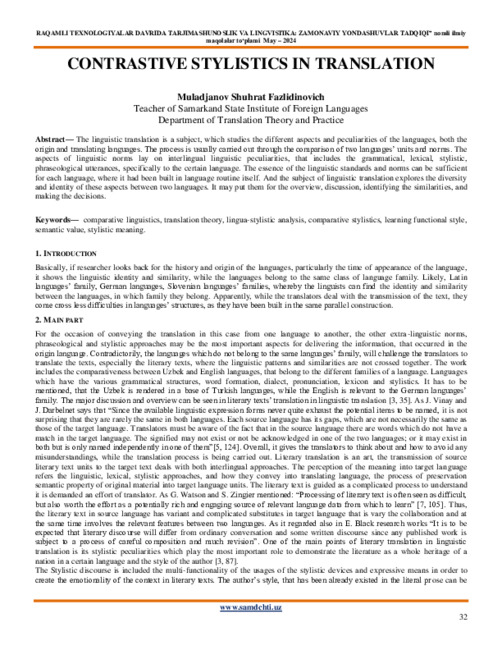
Contrastive stylistics in translation

Шухрат Муладжанов
The linguistic translation is a subject, which studies the different aspects and peculiarities of the languages, both the origin and translating languages. The process is usually carried out through the comparison of two languages’ units and norms. The aspects of linguistic norms lay on interlingual linguistic peculiarities, that includes the grammatical, lexical, stylistic, phraseological utterances, specifically to the certain language. The essence of the linguistic standards and norms can be sufficient for each language, where it had been built in language routine itself. And the subject of linguistic translation explores the diversity and identity of these aspects between two languages. It may put them for the overview, discussion, identifying the similarities, and making the decisions.
13-16 112 134

Tilshunoslikda kommunikatsiya nazariyasi hamda uning jarayonlashuviga doir

Акрам Шерматов

Mazkur maqolada tilshunoslikda kommunikatsiya terminining turli tadqiqotchi olimlar tomonidan taqdim etilgan ta’riflari, lingvistik nuqtai-nazardan olinganda kommunikatsiya terminining tildagi muhim qirralari haqida ozmi-ko‘pmi ilmiy ma’lumotlar o‘z aksini topgan. Shu bilan birgalikda, mazkur maqolada kommunikatsiyaning turlari, ularning lingvistikada tutgan funksional vazifalari hamda til tizimida jarayonlashuviga xos ma’lumotlar keltirilgan.

170-171 50 50

The role of IT technologies in our life and the importance of terms in use

Мадина Хайриева, Дилноза Унгалова

It is difficult to imagine the future of today's era without IT technologies, and for this reason, the study of this field remains the demand of the time. It is not for nothing that our president creates many conditions for training young people in this field and training qualified specialists. As the field of IT develops, studying related terms, studying the problems and tasks of translation from English, and developing terminological dictionaries creates a number of tasks for our linguists. We will talk widely about them in this article

16-18 54 19

Methods of teaching tempo and pace in the translation process

И. Аззамов

В данной статье важной задачей является качественное обучение темпу перевода в процессе устного перевода. Мы подчеркиваем, что обучение темпу должно быть введено с самого начала обучения науке, стресс или страх будет присутствовать в любом случае, но его эффект будет частично снижен в процессе практического перевода.

10-13 182 44

The translation of the political texts

Заррина Салиева, Феруза Явкочева, Нодира Парпиева

This study aims to address the primary challenges and issues that arise while translating political texts from English into Uzbek. The article intends to examine the teaching methods of political texts in translation in two languages - English and Uzbek. The article comprises an analysis of an English text translated into Uzbek. The research’s conclusions showed that teaching political writings linked to the English language in translation necessitates knowing and recognizing words and homonyms as well as employing a variety of translation techniques. Through these features given some analyzed and teaching methods arc given with the conclusion of the text analysis. Moreover, using these methods in translation is very helpful for students to understand political texts in English language.

18-21 57 29

Некоторые суждения о синтаксисе и современных концепциях

А. Ибаев

В лингвистике область синтаксиса тесно связана с морфологией и семантикой и интересуется критериями расположения частей речи (или классов слов) в предложении. Не секрет, что построение предложения (согласно теоретическим инструкциям), структура синтагмы, роль и расположение компонентов в простом предложении, а также их функциональные взаимосвязи, позиционные отношения в сложном предложении и т.д. считаются объектом изучения синтаксиса. В этой статье дается интерпретация этих и подобных вопросов.

21-23 43 89

Sinxron tarjima fan s1fatida о q1tilishining nazariy tendensiyalari

Навруз Даминов

Mazkur maqola sinxron tarjima usulining jamiyatda keng qo‘llanishini, uning murakkabligini fan sifatida tadqiq qiladi. Sinxron tarjima, ma’ruza va muzokaralarda, diplomatik uchrashuvlarda, savdo-sotiqda va boshqa sohalarda ommaviy nutqni tarjima qilishning maxsus usuli sifatida qo‘llaniladi. Ushbu usul nutq mazmunini boshqa tillarda tarjima shaklida yetkazadi. O‘zbek tilidan chet tiliga va chet tilidan o‘zbek tiliga tezkor, bexato, adekvat tarjima qilish sinxron tarjimaning asosiy maqsadi hisoblanadi. Sinxron tarjima jarayonida tarjimonning har ikkala tilda yuqori bilimga cga bo‘lishi talab qilinadi. Jarayon juda murakkab bo‘lib, alohida qobiliyatlarga ega bo‘lish zarur bo‘ladi.

23-25 80 48

Types of translation techniques by the example of transformations

А. Касимова

В статье рассматриваются приемы перевода на грамматическом, лексическом, семантическом и структурном уровнях, их применение на примерах как на английском, так и на узбекском языках. Целенаправленное использование методов перевода при переводе каждого примера, их анализы и рекомендаций по проблеме перевода культурно специфичных слов, устойчивых выражений, реалий, понимания их исходного значения в ИТ и ПТ и их трансформации в процессе перевода.

25-27 66 32

Yomon niyat gap strukturali frazeologik birliklar

Ахмад Турсунов

Ushbu maqolada tarkibiy frazeologik birliklaming bir qator guruhlari ko’rib chiqiladi. Shu bilan birga, ushbu maqolada mavzuga oid jumla tuzilgan frazeologik birliklarga misollar keltirilgan. Bu misollar yordamida nutq jarayonida qo'llangan so'z birikmalari tasniflanadi. Bundan tashqari, mavzu yuzasidan taniqli tilshunos olimlaming fikriari ham keltiriladi.

27-29 54 22

O zbek va ingliz adabiyotida insonparvarlik g‘oyasining tarbiyaga bo‘lgan ta’siri

Дилафруз Гиясова

В данной статье рассматривается парадигма лингвокультурологии, возникшая в конце 20-го века как отдельная область исследований, фокусирующаяся на взаимосвязи между языком, культурой и психологией человека. В ней освещены основополагающие теории таких учёных, как В. Гумбольдт, А. Потебня, Л. Вайсгербер, А. Вейбицкая, труды которых внесли значительный вклад в формирование лингвокультурологии как дисциплины.
30-32 105 44

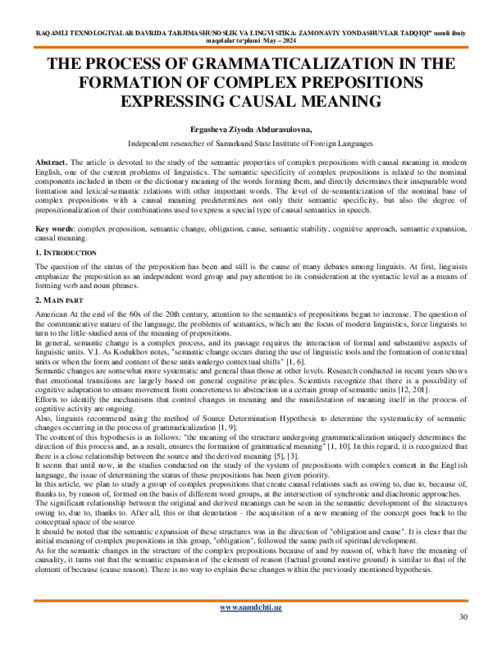
The process of grammaticalization in the formation of complex prepositions expressing causal meaning

Зиёда Ергашева
The article is devoted to the study of the semantic properties of complex prepositions with causal meaning in modem English, one of the current problems of linguistics. The semantic specificity of complex prepositions is related to the nominal components included in them or the dictionary meaning of the words forming them, and directly determines their inseparable word formation and lexical-semantic relations with other important words. The level of de-semanticization of the nominal base of complex prepositions with a causal meaning predetermines not only their semantic specificity, but also the degree of prepositionalization of their combinations used to express a special type of causal semantics in speech.
4-6 98 55

Tarjimada konseptlarni konversiv usulda ifodalashning pragmatik asoslari:antroposentrik yondashu v

Кулдошов Уктам, Улугбек Тайлакок

Ushbu maqolada tarjimada konseptlarni konversiv usulda ifodalashning pragmatik asoslari tahlil qilingan. Tarjimaga antropotscntrik yondashuv matnlarni bir tildan ikkinchi tilga tarjima qilish jarayonida inson madaniyati, idroki va tiliga e’tibor qaratishni anglatishligi asoslangan. Konseptlarning kognitiv harakatlar doirasida shakllanishi tavsiflangan. Tarjima jarayonining kognitiv xususiyatlari tahlili tarjima faoliyatini konseptlar bilan ishlashga chorlashligi ko’rsatib o’tilgan.
7-10 93 27

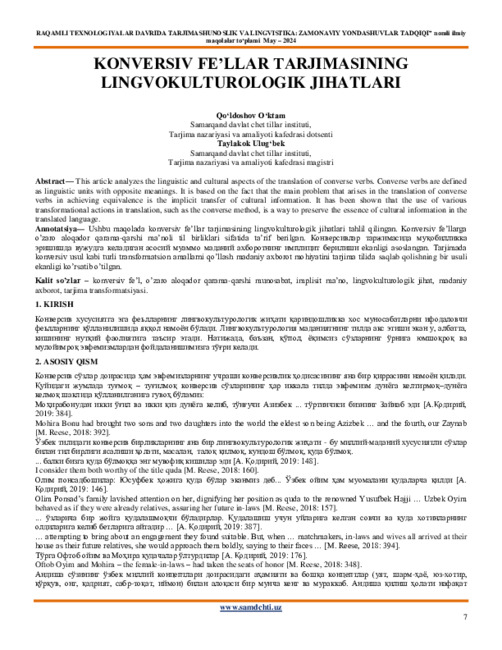
Konversiv fe’llar tarjimasining lingvokulturologik jihatlari

Уктам Колдошов, Улугбек Тайлакок

Ushbu maqolada konversiv fe’llar tarjimasining lingvokulturologik jihatlari tahlil qilingan. Konversiv fe’llarga o’zaro aloqador qarama-qarshi ma’noli til birliklari sifatida ta’rif berilgan. Конверсивлар таржимасида мукобилликка эришишда вужудга келадиган асосий муаммо маданий ахборотнинг имплицит бсрилиши ekanligi asoslangan. Tarjimada konversiv usul kabi turli transformatsion amallarni qo’llash madaniy axborot mohiyatini tarjima tilida saqlab qolishning bir usuli ekanligi ko’rsatib o’tilgan.

35-37 162 47

Kompyuter yordamida tarjima qilish yutug‘i va kamchiliklarining lingvistik tahlili

Мастура Облокулова, Турсунпулат Абдуллаев
Ushbu maqolada kompyuter yordamida tarjima qilishning yutuq va kamchiliklari tahlil qilingan. Mashina tarjimasi lingvistik tahlilining turli darajalari, ya’ni leksik, sintaktik, semantik va pragmatik jihatlar muhokm qilingan
37-40 368 163

Kompyuter tarjima dasturlari tarjimonning kasbiy kompetensiyasi sifatida

Турсунпулат Абдуллаев
Ushbu maqolada kompyuter tarjima dasturlarining tarjima sohasidagi ahamiyati, ularning tarjimon kasbiy kompetensiyasini shakllantirishdagi roli tahlil qilingan.
44-48 214 45

Translation challenges of literary works from Uzbek into english (in the example of A. Navoi’s ruboi)

Умида Абдурахмонова
Literary translation is a complex art that involves bridging linguistic, cultural, and artistic gaps between languages. When it comes to translating works from Uzbek to English, one encounters a plethora of challenges, particularly evident in masterpieces like Alisher Navoi’s ruboi. Navoi, a towering figure in Uzbek literature, crafted poetry that reflects the rich cultural heritage and poetic tradition of Central Asia. However, conveying the depth and beauty of his verses into English requires careful navigation through various obstacles. This article talks about these obstacles and how to overcome them, and analyzes the works of A. Navoi. This article delves into the myriad challenges encountered when translating Navoi's masterpiece into English.
40-44 69 61

Features of translating medical terms
Сарвиноз Абдуллаева
Medical translation is one of the most important fields in the modern world. The translation of medical terms into Uzbek is carried out in various ways. Transcoding eponyms has become widespread and firmly rooted in medical terminology and arc an indicator of scientific style, which ensures the effectiveness of professional intcrcultural communication. The purpose of this article is to present the transcoding and transformation options for the translation of English medical terms, as well as to discuss the importance of understanding the subject matter of the texts being translated, which is acquired with experience.
49-51 119 97

The significance of anthroponyms and toponyms in literary texts
Баходир Абдирасулов, Зиёмукхаммад Абдуракхманов
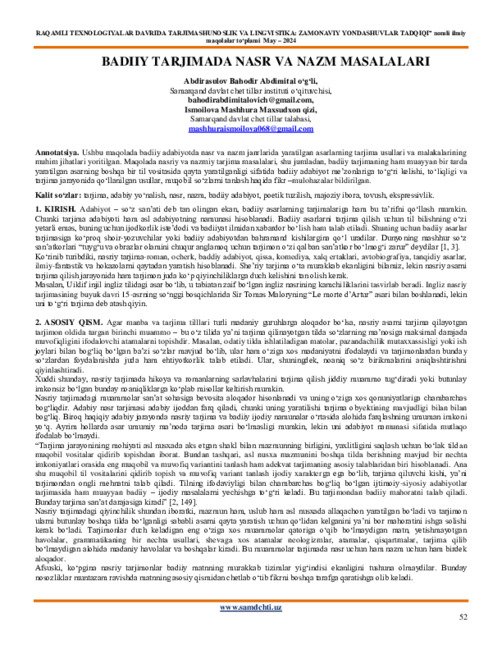
Anthroponyms and toponyms, referring to personal and place names respectively, are pivotal elements in literary texts, often carrying profound symbolic, cultural, and historical significance. This article explores the importance of anthroponyms and toponyms in enriching the narrative, enhancing the setting, and deepening the thematic exploration of literary works. Drawing on examples from various genres and cultures, the article illustrates how names can imbue characters with identity, reflect societal values, and establish a sense of place. Furthermore, it discusses how authors strategically employ names to create layers of meaning, evoke specific emotions, and engage readers on a more profound level. Through a detailed analysis, this article highlights the intricate role of anthroponyms and toponyms in shaping the literal־}' landscape and underscores their essential contribution to the overall meaning and impact of a text.
52-54 85 119

Badiiy tarjimada nasr va nazm masalalari
Баходир Абдирасулов, Машхура Исмоилова
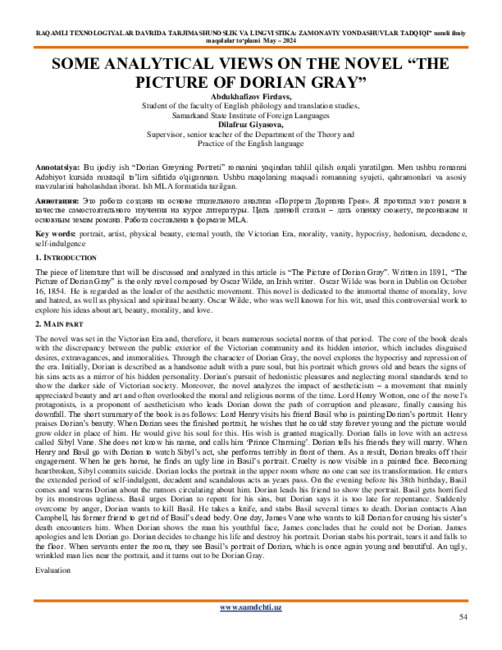
Ushbu maqolada badiiy adabiyotda nasr va nazm janrlarida yaratilgan asarlaming tarjima usullari va malakalarining muhim jihatlari yoritilgan. Maqolada nasriy va nazmiy tarjima masalalari, shu jumladan, badiiy tarjimaning ham muayyan bir turda yaratilgan asarning boshqa bir til vositasida qayta yaratilganligi sifatida badiiy adabiyot mc’zonlariga to'g'ri kclishi, to‘ liqligi va tarjima jarayonida qo’llanilgan usullar, muqobil so'zlarni tanlash haqida fikr mulohazalar bildirilgan.
54-58 110 50

Некоторые аналитические мнения о романе «Картина Дориан Грея»
Фирдавс Абдухафизов, Гиясова Дилафруз
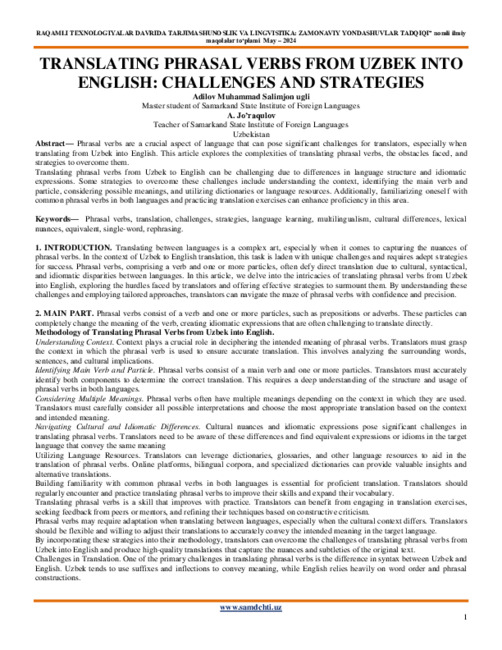
Эта работа создана на основе тщательного анализа «Портрета Дориана Грея». Я прочитал этот роман в качестве самостоятельного изучения на курсе литературы. Цель данной статьи - дать оценку сюжету, персонажам и основным темам романа. Работа составлена в формате МЬА.
59-60 81 109

Translating phrasal verbs from Uzbek into English: challenges and strategies

Мухаммад Адилов, А Журакулов
Phrasal verbs arc a crucial aspect of language that can pose significant challenges for translators, especially when translating from Uzbek into English. This article explores the complexities of translating phrasal verbs, the obstacles faced, and strategies to overcome them.
Translating phrasal verbs from Uzbek to English can be challenging due to differences in language structure and idiomatic expressions. Some strategies to overcome these challenges include understanding the context, identifying the main verb and particle, considering possible meanings, and utilizing dictionaries or language resources. Additionally, familiarizing oneself with common phrasal verbs in both languages and practicing translation exercises can enhance proficiency in this area.
61-62 118 43

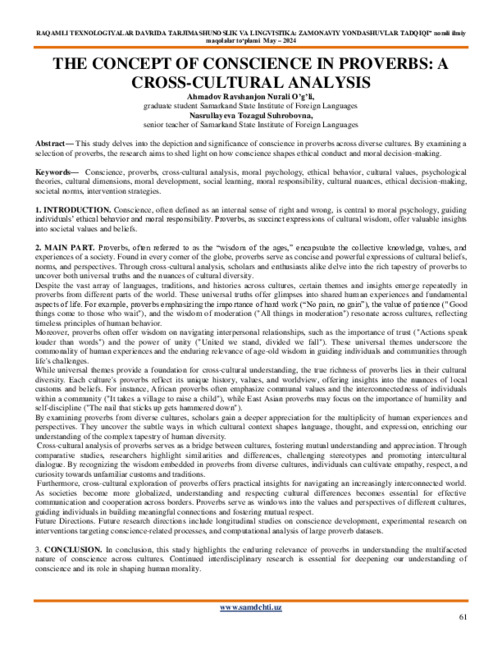
The concept of conscience in proverbs: a cross-cultural analysis

Равшанжон Ахмадов, Тозагул Насруллаева
This study delves into the depiction and significance of conscience in proverbs across diverse cultures. By examining a selection of proverbs, the research aims to shed light on how conscience shapes ethical conduct and moral decision-making.
62-65 55 36

Aforizmlarning xorijiy tillarni o‘qitishdagi metodologik ahamiyati
Гульзебо Ахмедова
Ushbu maqolada xorijiy tillarni o‘qitishda aforizmlardan foydalanish masalasi ko‘rib chiqilgan. Aforizmlarda tilning o‘ziga xos milliyligi aks ctganligi tufayli, aforizmlar talabalarga boshqa millat madaniyati to‘g‘risida ma’himot olishga, xorijiy tildagi nulqni to‘g‘ri tushunishga, hamda talabalarning lug‘at boyliklarini oshirishga yordam beradi. Aforizmlardan samarali foydalanish talabalarning tilning barcha darajalarida: fonetik, leksik va grammatik jihatdan muloqot qobiliyatini rivojlantirishi mumkin.
66-68 120 44

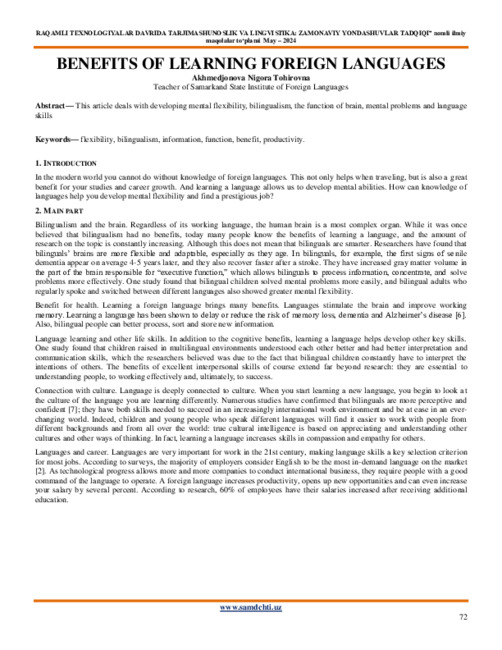
Gerunds in translating scientific and technical texts
Заррина Салиева, Севара Ахророва, Гульноза Кадирова
The translation of scientific and technical texts poses unique challenges, requiring not only linguistic fluency but also a deep understanding of complex subject matter. Among the linguistic tools employed in this endeavor, gerunds stand out as crucial elements facilitating accurate and effective communication. This article explores the pivotal role of gerunds in the translation of scientific and technical texts, elucidating their multifaceted functions and inherent challenges. In scientific and technical contexts, where precision and clarity are paramount, the judicious use of gerunds enables translators to convey intricate scientific phenomena and elaborate technical procedures with fidelity to the source text.
72-73 160 72

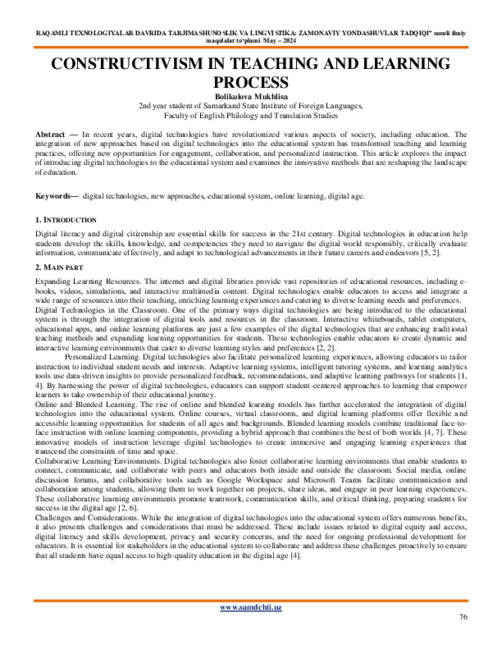
Benefits of learning foreign languages
Нигора Акхмеджонова
This article deals with developing mental flexibility, bilingualism, the function of brain, mental problems and language skills
76-77 72 28

Constructivism in teaching and learning process
Мухлиса Боликулова
In recent years, digital technologies have revolutionized various aspects of society, including education. The integration of new approaches based on digital technologies into the educational system has transformed teaching and learning practices, offering new opportunities for engagement, collaboration, and personalized instruction. This article explores the impact of introducing digital technologies to the educational system and examines the innovative methods that are reshaping the landscape of education.
73-76 154 60

Problems of non-equivalent words in uzbek-english translations
Факхриддин Бакиев, Шакхноза Акхмедова
This article is dedicated an interesting development in fiction, abetted by Modernism, was a shift from naturalistic to poetic writing. There was an increased tendency to select details and endow them with symbolic meaning, to set down the thought processes and emotions of the characters, and to make use of rhythmic prose.
82-84 115 28

Ingliz va o‘zbek tillaridagi qishloq xo‘jaligiga oid matnlarida ko‘rsatish hodisasining xususiyatlariga doir

Муниса Бозорова
Ilmiy matnda muallif o‘zining nutqini qisqa ravon va izchil bayon etishi lozim. Ilmiy matnlarga xos bo‘lgan atamalardan foydalanish matnni to‘liq shakllantirsada, ba’zi holatlarda ulardan foydalanishni ham kamaytirish lozim bo'ladi, mazkur holatda ulami ko‘rsatish vositalaridan foydalangan holda bayon qilish matnni mazmunini boyitadi. Mazkur maqola qishloq xojaligiga oid inlgiz va okzbek tilidagi matnlarda ko‘rsatish xususiyatining ba’zi holatlarini ko‘rib chiqadi va ular o‘rtasidagi o‘xshashliklar va farqlami ko‘rsatib bcradi.
84-89 252 81

Mindset transformation through fiction reading
Диёра Джуракулова
Research has shown that reading fiction promotes empathy and increases social acuity. Through reading, we are exposed to a wide range of human experiences and emotions, which expands our understanding of the world and the people around us. We are able to see the world through different lenses and develop a more nuanced perspective. Additionally, reading fiction can help us develop a growth mindset. Books often contain characters who undergo personal transformations and overcome challenges. These stories can inspire us to adopt a similar mindset and believe in our own ability to grow and change. By seeing characters in fiction navigate obstacles and learn from failures, we can learn to approach our own lives with a similar mindset of resilience and growth.
89-95 178 77

The science of adolescent brain development
Диёра Джуракулова
Adolescence is a pivotal stage marked by profound physical, emotional, and cognitive changes. At the core of this transformative period lies the intricate science of adolescent brain development. Understanding how the adolescent brain evolves holds immense significance for parents, educators, and policymakers alike.
95-96 108 49

Exploring syntactic features in literary dialogue translation: a computational perspective
Ситора Ергашова
Translation of literary dialogue presents a unique challenge due to its nuanccd syntactic features that convey not only the words spoken but also the cultural context, emotions, and interpersonal dynamics of the characters. In this article, we delve into the computational analysis of syntactic features in literary dialogue translation. Drawing upon linguistic theories and computational methodologies, we explore how syntactic structures influence the translation process and impact the fidelity of conveying the original meaning and style. Through a comprehensive review of existing research and case studies, we elucidate the role of syntax in preserving the authenticity and literary quality of translated dialogue. Additionally, we discuss emerging technologies and computational tools that aid in the translation of literary dialogue, paving the way for more accurate and culturally sensitive translations.
97-99 74 57

Сравнительный анализ образовательных систем Финляндии и Узбекистана

Фирдавс Ибадуллаев
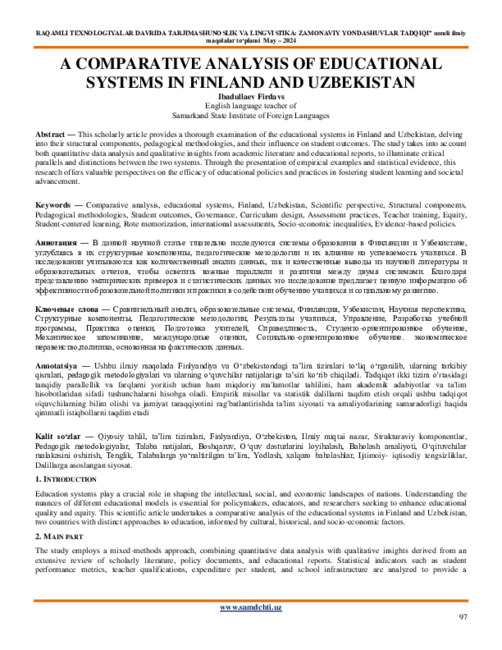
В данной научной статье тщательно исследуются системы образования в Финляндии и Узбекистане, углубляясь в их структурные компоненты, педагогические методологии и их влияние на успеваемость учащихся. В исследовании учитываются как количественный анализ данных, так и качественные выводы из научной литературы и образовательных отчетов, чтобы осветить важные параллели и различия между двумя системами. Благодаря представлению эмпирических примеров и статистических данных это исследование предлагает ценную информацию об эффективности образовательной политики и практики в содействии обучению учащихся и социальному развитию.
99-102 125 33

Значимость психолингвистики в современной эпохе и научном исследовании

Нигина Икромова, Нигина Икромова
Психолингвистика играет важную роль в современном мире, помогая понять и объяснить множество явлений, связанных с речевой деятельностью. Ее применение в глобальной сфере позволяет решать различные проблемы и задачи, связанные с межкультурным общением, образованием, политикой и другими аспектами жизни общества. Данная статья рассматривает ряд вопросов касательно данной области лингвистики. А так же ведется изучение общий их отличительных черт трех лингвистических областей. Приведены примеры и их анализ с точки зрения метода теоретического анализа.
102-104 111 75

Интерпретация стилистических приемов из английского языка на узбекский язык

Сокина Исматиллоева
В этой статье исследуется искусство интерпретации стилистических приемов, таких как метафоры, сравнения, персонификация и аллитерация, с английского на узбекский язык. Перевод стилистических приемов с английского на узбекский язык представляет собой увлекательную задачу из-за сложности лингвистических структур и культурных нюансов. Этот процесс включает в себя не только перевод буквального значения, но и уловление поэтической сути и художественного таланта оригинального текста. Культурная чувствительность, креативность и глубокое понимание обоих языков необходимы.
105-107 58 24

Multilingual communication in the process of translation

Донокхон Жураева, Лейла Xолмурадова
This article probes the intricacies of multilingual communication within the processes of translation and simultaneous interpretation. Through the lenses of professional practice, sociolinguistic theory, and real-time analysis, it analyzes the challenges and strategies involved in managing multiple languages. Highlighting the profound impact of effective multilingual communication on cultural understanding, it argues for enhanced education and technology integration in both professional and academic settings. By bridging theory with practice, this work not only sheds light on the current landscape of global communication but also proposes concrete steps toward a more connected and inclusive future.
108-109 41 35

Translation methods of anthropocentric phraseological units in the uzbek and english languages

Джамшид Жозилов
This study analyzes translation methods for anthropocentric phrases in Uzbek and English, focusing on challenges and strategies. It explores cultural and linguistic differences' impact on conveying anthropocentric concepts accurately. Examining examples from both languages enhances understanding of cross-cultural communication and linguistic adaptation in translation studies.
109-110 53 22

The role of memory and sleep in simultaneous translation

Асомиддин Жумаев
This thesis is aboutimportance of building correct lifestyle of translators.Since they transfer information from one language into another. At that time, they need good memory and brain in order to keep gist of main information. Sleep can contribute to create special memory skills. Because of normal circadian rhythm, they may achieve accomplishments during their work.
111-113 104 52

Стратегии перевода лингвокультурных единиц

Чарос Жуманазарова
Перевод — это сложный процесс, особенно когда речь идет о переводе лингвокультурных единиц, это может быть очень сложной задачей. Это требует глубокого понимания как исходного, так и целевого языков и культур. Лингвокультурные единицы охватывают широкий спектр выражений, таких как идиомы, пословицы, метафоры и культурно специфические термины, которые несут не только лингвистическое значение, но и культурную ценность. Эти единицы часто отражают уникальную историю, традиции и обычаи конкретной нации, что делает их трудными для прямого перевода из-за ограниченного соответствия и, возможно, отсутствия понимания в целевой культуре. Данная статья исследует различные стратегии эффективного перевода лингвокультурных единиц и углубляется в методы, такие как перевод посредством культурной замены, парафразы, культурного эквивалента и натурализации. Понимая и применяя эти стратегии, переводчики могут преодолеть культурные разрывы и улучшить межкультурное общение.
113-114 44 22

Ingliz tilida leksik derivatsiyaning voqelanishi

Илхом Каримов
Shuni alohida qayd ctish lozimki, so‘z yasalishi muammosi tilshunoslik fanining kcyingi taraqqiyoti davriga kclib tadqiqotlar кип tartibidagi asosiy va nufuzli masalalardan biriga aylandi. Bu masalaning grammatikada yohud Icksikologiyada o‘rganilishiga ham aynan ana shu davrda chek qo‘yildi.
115-116 677 151

Publitsistik matn xususiyatlari va tarjima qilish usullari

Асрор Юсупов
Publitsistik matnlar yozma muloqotda muhim o’rin tutuvchi fikrlarni yetkazish, tahlil qilish va tadqiq etish uchun asosiy vosita bo’lib xizmat qiladi. Ushbu maqola publitsistik matn va uslubining o’ziga xos xususiyatlarini yoritishga va ularni tarjima qilishda qo’llaniladigan turli usullarni o’rganishga qaratilgan. Tilshunoslik va tarjimashunoslik nazariyalariga tayangan holda ushbu tadqiqot publitsistik matnlarni tarjima qilishning nozik tomonlari va qiyinchiliklarini ochib berish uchun misoliar bilan boyitilgan keng qamrovli tahlillami taqdim etadi. Ushbu tadqiqot orqali o’quvchilar turli tillarda jumalistik nutqning mohiyati va uslubini saqlab qolishning murakkabliklari haqida tushunchaga ega bo’ladilar..
117-119 74 86

Derivatologiya muammolari jahon tilshunoslari talqinida

Илхом Каримов
Ushbu maqola derivatsiyaning ko’p qirrali tabiati haqida qisqacha ma’lumot beradi va uning turli xil ta’lim sohalaridagi ahamiyatini ta’kidlaydi.
119-120 51 33

Transforming interpretation pedagogy: exploring interactive methods and techniques

Лайло Касимова
This comprehensive review explores the significance of interactive pedagogy in interpretation training, examining its impact on student engagement, skill acquisition, and professional development. It discusses the benefits, challenges, and practical applications of interactive methods in interpretation instruction, drawing on current research and practical examples to provide insights into the effectiveness of such methods.
123-124 103 52

Translating idioms and cultural references. Navigating linguistic and cultural challenges

Анора Мадримова
Learning idioms is one of the most important parts for every learner. Because idioms arc semantically deep and somewhat difficult to learn. Because idioms arc a part of language with a very deep and beautiful meaning, they attract attention through various metaphorical meanings. Idioms are translated with different meanings in different cultures, and translating idioms literally is also the biggest mistake.
127-129 103 28

The role of technology in enhancing simultaneous interpretation skills for young interpreters

Сожида Маматова, Заррина Салиева
This article explores how technology is revolutionizing the field of simultaneous interpretation, particularly for young interpreters. It discusses various technological advancements, including specialized software and hardware solutions, remote interpretation platforms, Al and machine learning algorithms, virtual reality (VR) and augmented reality (AR), and cloud-based collaboration platforms. The article emphasizes the benefits of technology in improving interpretation skills while also addressing challenges and considerations such as accessibility, data security, and professional development.
125-126 116 34

Pioneers of simultaneous interpretation

Чарос Козокова, Мафтуна Махмудова
This scientific article delves into the evolution of simultaneous interpretation (SI) by exploring its foundations, pioneers, techniques, and tools. By examining the historical roots of this practice and highlighting the contributions of key figures in the field, a comprehensive understanding of simultaneous interpretation’s development is presented. The article also provides insights into the comparison between the traditional methods of simultaneous interpretation and its contemporary applications, showcasing the advancements and innovations that have shaped the practice into what it is today. Through a detailed analysis of past practices and current trends, this article offers a nuanced perspective on the transformative journey of simultaneous interpretation.
130-131 35 20

Constructivism in teaching and learning process
Шакхзода Маматюсуфова
This paper explores the strategies employed by simultaneous interpreters during the interpretation process. The article also analyzes the challenges faced by interpreters and offers insights into effective strategies for improving interpretation performance. Simultaneous interpreting presents a unique set of challenges, requiring interpreters to process and translate speech in real-time. Speech compression is a strategy that has gained attention for its potential to improve the accuracy and comprehension of interpretations. This article explores the application of speech compression in the simultaneous interpreting process and its impact on interpreter performance.
132-134 49 22

Роль методики при использовании интернет-ресурсов при обучении иностранному языку
Дилшода Махмудова
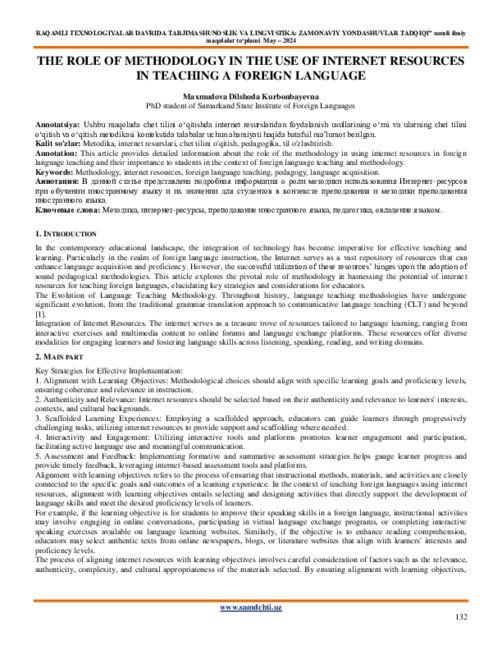
В данной статье представлена подробная информация о роли методики использования Интернет-ресурсов при обучении иностранному языку и их значении для студентов в контексте преподавания и методики преподавания иностранного языка
135-137 64 33

Pragmatic aspects of simultaneous interpretation and its difference from other types of translation

Анвар Мирзакулов
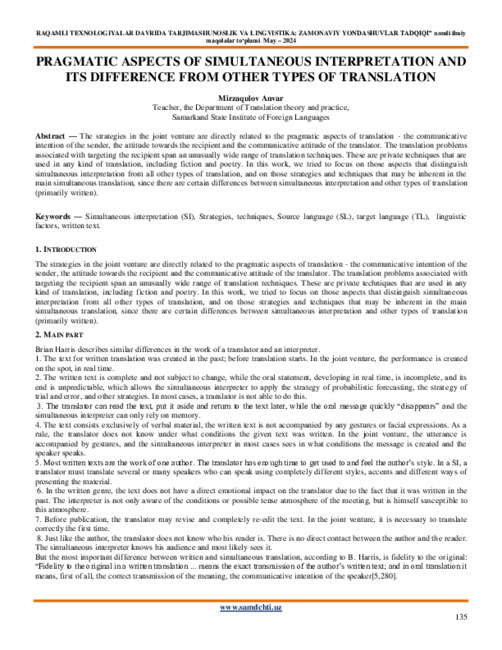
The strategies in the joint venture are directly related to the pragmatic aspects of translation - the communicative intention of the sender, the attitude towards the recipient and the communicative attitude of the translator. The translation problems associated with targeting the recipient span an unusually wide range of translation techniques. These arc private techniques that are used in any kind of translation, including fiction and poetry. In this work, we tried to focus on those aspects that distinguish simultaneous interpretation from all other types of translation, and on those strategies and techniques that may be inherent in the main simultaneous translation, since there are certain differences between simultaneous interpretation and other types of translation (primarily written).
137-139 75 155

Лексико-семантическая особенность перевода терминов

Ж Мирзоев
В данной статье анализируются перевод терминов и их лексико-семантические особенности на таджикский, русский английский языки. Также изучалось образование новых терминов путём разделения их на группы.
140-142 79 23

Constructivism in teaching and learning process

Заррина Салиева, Мохира Юлчиева, Дилобар Худойназарова
In this article, the problem of translating military documents from English to Uzbek is discussed. The fact that the translators do not have sufficient military knowledge shows the problems and intricacies. This study uses a quantitative method to investigate and discuss the difficulty of translating military texts from English to Uzbek. The aim of this study is to emphasize the difficulty of transferring military texts. The current study uses both qualitative and quantitative methods to identify and analyze the real problem behind the translating of military texts.
142-144 107 28

Translating conceptual metaphors of time to in english and uzbek using the schema activation model

Мохинур Мухаммедова
Time-related conceptual metaphors are common in both Uzbek and English and are effective tools for expressing the semantic meaning. Certain variations in linguistic structures and cultural circumstances make translating metaphors between languages difficult. This article investigates the translation of English conceptual metaphors connected to time into Uzbek using the schema activation model. It demonstrates how this paradigm might be used in practice while pointing out the variations and difficulties that come with preserving the metaphor’s original significance and impact.
145-147 64 30

Constructivism in teaching and learning process

Лейла Холмурадова, Абдулазиз Норбоев
This article examines animal symbolism in English and Uzbek phraseological units, emphasizing their linguocultural significance. It explores how idioms serve as cultural artifacts, encapsulating the essence of a society’s history and values. The study analyzes idioms through qualitative and quantitative methods, revealing the pivotal role of symbolism in phraseology. It discusses the influence of linguistic and extra-linguistic factors, such as stylistics, culture, and cognitive linguistics, on the symbolization of phraseological units. By comparing the symbolic meanings of animals like the wolf, fox, and sheep in both languages, the article highlights the deep connections between language, culture, and human experience, offering insights into cross-cultural communication and linguocultural understanding.
149-150 81 23

Stylistic and pragmatic functions of language tools in translation from English into Uzbek

Мадина Нуруллаева
Translation is a complex process that goes beyond mere linguistic conversion; it involves capturing the essence, style, and intended meaning of the original text in the target language. This article delves into the stylistic and pragmatic functions of language tools in the translation from English into Uzbek. Through an analysis of various language tools and their application in translation, this article highlights the importance of maintaining both stylistic coherence and pragmatic accuracy to ensure effective communication and cultural resonance in the target language. Drawing on examples and case studies, this article offers insights into the challenges faced by translators and provides strategies for overcoming them, ultimately contributing to the advancement of translation studies, particularly in the context of English to Uzbek translation.
151-152 61 45

The role of plants in the text of riddles in both english and uzbek languages
Шахноза Очилова
This article delves into the fascinating role of plants in the context of riddles, examining how flora is intricately woven into the fabric of enigmatic language puzzles in both English and Uzbek cultures, adding layers of complexity, metaphor, and cultural significance to the art of riddling.
152-155 78 29

Translationof oil and gas industry lexis

Заррина Салиева, Шакхло Уринова
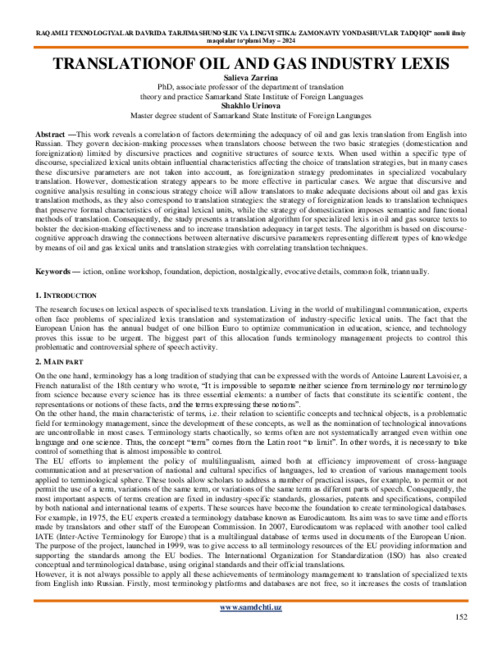
This work reveals a correlation of factors determining the adequacy of oil and gas lexis translation from English into Russian. They govern decision-making processes when translators choose between the two basic strategics (domestication and forcignization) limited by discursive practices and cognitive structures of source texts. When used within a specific type of discourse, specialized lexical units obtain influential characteristics affecting the choice of translation strategies, but in many cases these discursive parameters are not taken into account, as foreignization strategy predominates in specialized vocabulary translation. However, domestication strategy appears to be more effective in particular cases. We argue that discursive and cognitive analysis resulting in conscious strategy choice will allow translators to make adequate decisions about oil and gas lexis translation methods, as they also correspond to translation strategics: the strategy of forcignization leads to translation techniques that preserve formal characteristics of original lexical units, while the strategy of domestication imposes semantic and functional methods of translation. Consequently, the study presents a translation algorithm for specialized lexis in oil and gas source texts to bolster the decision-making effectiveness and to increase translation adequacy in target tests. The algorithm is based on discourse-cognitive approach drawing the connections between alternative discursive parameters representing different types of knowledge by means of oil and gas lexical units and translation strategies with correlating translation techniques.
156-158 64 42

Formation of english compounds and their traslation

Мохинур Каимова
The study of word formation of compounds is currently so confused that crafting an introduction to the topic without controversy seems unattainable and the method of creating words in English is examined in various educational materials and lexicons written by different scholars.This article focuses on the discussion of formation of compounds, compounding as one of the means of word- formation in English, as well as its criteria.
158-160 109 84

Equivalence and equivalent effect of translation of literary devices in “The Kite runner” by Khaled Hosseini

Факхриддин Бакиев, Гульноза Кадирова
This article explores the translation of literary works that involves transforming the original content into another language while preserving its meaning, style and cultural nuances. One critical aspect of translation is maintaining the equivalence and equivalent effect of literary devices, which play a vital role in conveying the author’s intentions. This article highlights the historical context, key figures, the impact of equivalence and equivalent effect of translation of literary devices in The Kite Runner by Khaled Hosscini, identifies and analyzes influential individuals who have contributed to the field, discusses various perspectives and provides a well-reasoned analysis.
161-162 83 36

Main features of technical texts

Тозагул Насруллаева, Хуснора Курбонова
Translation of technical texts plays a crucial role in facilitating cross-cultural communication and knowledge dissemination in various fields, including engineering, medicine, and information technology. However, the process of translating technical content presents unique challenges, often resulting in errors that impact the accuracy and readability of the translated texts. Understanding the nature of these errors and their underlying stylistic and lexical features is essential for improving translation quality and ensuring effective communication in technical domains. The actuality of this article is due to the increasing importance of translation of scientific and technical literature as a way of exchanging and disseminating information in the global scientific community.
163-164 45 19

The importancy of training gastronomy translator

Мухайё Сафаева
The tourism sector, which is considered one of the main links of the economy in many countries of the world, is one of the most advanced sectors of some developed countries. As a result of the comprehensive development of the tourism industry, its various directions have appeared. One of such new promising areas is gastronomic tourism, which will have aspects that reflect the culture of the nations. As a result of the development of the field of gastronomic tourism, the study of the field from the point of view of linguistics and translation studies is gaining relevance, and this problem occupies a reasonable place on the research agenda.
164-165 51 27

Перевод текстов и правовых документов по защите гражданских прав

Хуршида Шерматова
В данной статье исследуется значение точного и эффективного перевода текстовых и юридических документов в контексте защиты гражданских прав. В нем также рассматриваются проблемы, связанные с переводом юридических текстов, и подчеркивается важность лингвистической и культурной компетентности в процессе перевода. Кроме того, в статье рассматривается место письменных и устных переводчиков при переводе юридических документов и их роль в общении лиц с ограниченным знанием языка и юридическим профессионализмом.
166-167 111 48

Tarjimashunoslikda uchraydigan muammolar
Парвина Туйчиева
Bilamizki globallashuv jarayoni shiddat bilan rivojlanib keng tarqalib bormoqda, shu bilan birga har bir soha, har bir yo'nalishda 0‘ziga yarasha 0‘zgarishlar, yangiliklar kundan kunga ko'payib bormoqda. Axborot texnologiyalari rivojlanayotgan paytda sohaga bo'lgan talab ham jadallik bilan rivojlanib kelmoqda.
168-170 120 61

It atamalarini ingliz tilidan o‘zbek tiliga tarjima qilishdagi muammolar

Тозагул Насруллаева, Дилноза Унгалова
Globallashuv jarayoni ko‘plab tillarning ichki va tashqi manbalar orqali boyish imkoniyatini oshirmoqda. Jahon va milliy tillar maydoniga ko‘plab yangi so’zlar, atamalar va so‘z birikmalari kirib bormoqda. Ayniqsa, axborot-telekommunikatsiya tizmidagi yangiliklar bunday birliklaming yanada keng ildiz otishiga sabab bo‘lmoqda. Shu jumladan IT sohasidagi yangi atamalarning kelib chiqishi ulami tarjima qilish borasida qator yechilishi lozim masalalar borki, ularga o’z o’mida hal etilishi joiz. Maqolada ayni muammolar va ularga olimlarning yechimlari haqida so‘z yuritamiz.
172-174 47 175

Selection of image tools with communicative function in translation
Мадина Хайриева, Мадина Нуруллаева
The selection of image tools with a communicative function in translation is a crucial aspect of effective cross-cultural communication. Images possess the power to transcend language barriers, enhance comprehension, and evoke emotions, making them invaluable assets in the translation process. This article explores the multi faceted considerations involved in choosing appropriate images for translation, emphasizing the importance of understanding the target audience, context, message, and cultural nuances. By carefully selecting and integrating images, translators can bridge cultural gaps, create engaging experiences, and ensure the intended message resonates with the audience on a deeper level.
174-177 261 136

Using AI translation technology in enhancing cultural communication

Мадина Хайриева, Шакхноза Акхмедова, Умар Ергашев
In today’s world, it’s important to be able to communicate in different languages for work and personal reasons. Language differences can make it hard to communicate well. This can cause problems and misunderstandings. Thankfully, technology can help overcome these problems and improve understanding between different cultures. Here are some good ways to use technology to talk to people who speak different languages.
Technology has helped people from different cultures communicate better with translation tools and platforms. These tools make it easier for people who speak different languages to understand each other and communicate well. Technology like Google Translate and Microsoft Translator helps people from different cultures talk to each other easier. These tools use smart computer programs to change words, speech, and pictures into different languages. Everybody’s talking about ChatGPT.The artificial intelligence chatbot, developed by private company OpcnAI, allows a user to generate content. It can create poems, articles, short stories, and even jokes.
180-182 89 24

Ingliz va oʻzbek tillarida murakkab sintaktik qurilmalarning derivatsion xususiyatlari xususida mulohazalar

Раззок Худойкулов
Maqola murakkab sintaktik qurilmalardagi komponentlarning o’rtasidagi o’zaro munosabatlarni tahlil qiladi, ular orasidagi semantik va sintaktik aloqalami ingliz va o’zbek tilida keltirilgan misoliar yordamida derivatsiya nuqtayi nazaridan o’rganadi
182-185 67 119

Образование неологизмов и их классификация

Наргиза Юлдошева
Неологизмы, или вновь появившиеся слова и выражения, являются фундаментальным аспектом эволюции языка. В этой статье рассматриваются различные процессы, посредством которых образуются неологизмы, и предлагается всеобъемлющая система классификации для их отнесения к определенной категории. Каждый из этих процессов определен и проиллюстрирован примерами. В статье также рассматриваются мотивы создания неологизмов, роль технологий и социальных сетей, а также критерии приемлемости и долговечности неологизмов. Предлагаемая система классификации обеспечивает основу для лучшего понимания и исследования неологизмов как с лингвистической, так и с социокультурной точек зрения
185-186 57 1310

The role of anticipation skills in simultaneous interpretation: a critical analysis

Чарос Козокова, Фазилат Ёлдошева
This study examines the memory and language skills of simultaneous interpreters, focusing on the impact of expertise and language proficiency. The article highlights the role of skilled interpreters in predicting upcoming words, suggesting that anticipation plays a significant role in interpreting performance. There arcscvcral works which were used to highlight how the ability to predict upcoming content can be used in practice and improve overall performance.
187-188 68 24

Frazeologik birliklarni tarjimada berishning nazariy usullari

Дилором Юнусова, Зафар Рустамов
Mazkur maqola tilning leksik birliklariga nisbatan birmuncha murakkab tarkibli lisoniy vositalari bo‘lmish frazeologik birliklami tarjimada adekvat talqin etish masalasiga bag‘ishlanadi. Chunki frazeologik birliklar nutqning badiiy-tasviriy vositalari sifatida fikrning oddiy, betaraf bayonidan ko‘ra kolproq turli-tuman uslubiy vazifalarni ifoda etishda ishtirok ctadilarki, ularning ushbu vazifalarini hisobga olgan holda, ularni tarjimada bejirim talqin ctishga intilish badiiy asaming obrazli hamda hissiy-tasviriy qiymatini qayta yaratish yoMidagi jonbozlik bilan chambarchas bog‘liqdir.
189-190 39 34

The importance of translation strategies in the translation process

Махлиё Юсупова, Фируза Халимова
Translation serves as a bridge between languages and cultures, facilitating communication and understanding across borders. However, the translation process is complex, requiring more than just linguistic proficiency. This article delves into the importance of translation strategies in ensuring accurate, culturally sensitive, and effective translations. By examining various translation strategies and their role in overcoming linguistic and cultural barriers, this article highlights their significance in enhancing cross-cultural communication.
190-191 50 26

Achievements and shortcomings of translation of current scientific works

Мохира Зиядуллаева, Xикматилло Мамадалиев
One of the main areas of attention is the study of language and terminological difficulties associated with the translation of scientific literature. To help translators in their work, this includes identifying field-specific terminology, investigating ways to resolve linguistic difficulties, and creating specialized dictionaries and databases.
192-194 39 26

O’zbek o‘quvchilariga ingliz tilidagi bog'lovchi mavzusininggrammatik xususiyatlarini o’rgatishda turli metodlardan foydalanish

Фаризабону Абророва
Ushbu maqolada ingliz tilidagi bog'lovchi turlari mavzusi haqida so'z borgan. Shu bilan bir qatorda ushbu mavzuning grammatik xususiyatlarni o’rgatish uchun turli metodlardan foydalanish yoritib berilgan
195-196 72 23

Consecutive interpretation of presentations presented at conferences and negotiations (on scientific topics)

Динора Журамуродова
Consecutive interpretation of presentations at conferences and negotiations on scientific topics is a crucial aspect of facilitating effective communication between speakers and participants from diverse linguistic backgrounds. This study explores the challenges and strategies involved in providing accurate, culturally sensitive interpretation in high-pressure settings. By analyzing the role of interpreters in conveying complex scientific concepts and maintaining the integrity of the message, this article sheds light on the importance of skilled language professionals in bridging communication gaps in international contexts. Ultimately, the findings underscore the significance of rigorous training and professional development for interpreters in ensuring successful cross-cultural communication in the scientific community.
196-197 46 13

Consecutive interpreting of messages across variousc fields presented by mass media

Сабрина Мустафоева
This article explores the challenges and strategies involved in consecutive interpreting of messages from diverse domains,such as politics,economics,and culture,as disseminated through mass media platforms. By examining the complexities and nuances of this translation method and aim is to find the best practices for effective consecutive interpreting in the context of mass media communication.
198-199 28 15

Consecutive interpreting of messages across various fields presented by mass media

Дилшода Шайматова
This article examines the problems and difficulties and techniques associated with the sequential interpretation of various messages in the fields of economy, politics, ecology, sports, art, etc., disseminated through mass media. The main purpose of doing this is to find the best methods for translating the messages that are distributed by the mass media.
223-226 61 43

Исследование профессиональной компетентности переводчиков
Дилдора Хасанова
В условиях глобализации экономики и высоких технологий, а также все более частых обменов между странами спрос на переводчиков высокого уровня постоянно растет. Таким образом, в данной статье излагаются профессиональные компетенции, необходимые переводчику, включая основные и вспомогательные компетенции. Основная компетенция состоит из владения двумя языками, межкультурных знаний и навыков, тесно связанных с устным переводом, дополнительные возможности включают психологические качества, концентрацию и выносливость, а также соответствующий дресс-код и стиль интерпритации. В статье в первую очередь утверждается, что студенты-переводчики должны иметь четкое представление о требованиях к профессиональной компетентности переводчиков, чтобы они могли как можно раньше стать квалифицированными переводчиками.
226-228 79 34

Ijtimoiy tarmoqlarning diskursiv xususiyalari

Покиза Саломова, Нигора Ахмеджонова
Ushbu maqolada ijtimoiy tarmoqlarning bugungi kundagi o‘rni va uning diskursiv xususiyatlari o‘z ifodasini topgan.
228-229 110 64

Elizabet Geskelning “Shimol va janub” asarining til madaniyati va lingvokognitiv xususiyatlari

Гавхар Раджапова
Ushbu maqolada sanoat inqilobi davrida adabiy marvarid sifatida paydo bo‘lgan Elizabet Gaskelning “Shimol va Janub" nomli asari, hamda asardagi davrning dinamik til madaniyati va lingvokognitiv nozikliklari muhokama qilingan. Turli tabaqaga oid asar qahramonlar orqali buyuk industrial rivojlanish davrida rivojlanayotgan til va tilning kognitiv jarayonlari tahlil qilingan.
230-231 292 88

Lingvokulturologiyada lingvomadaniy birliklarning roli va o‘rni

Зарина Рахматова
Ushbu maqolada lingvokulturologiya fanining til oTganishdagi roli va ahamiyati haqida malumotlar beriladi. Lingvokulturologiyadagi lingvomadaniy birliklaming tilni oTganishdagi o‘ziga xos jihatlari haqida gapiriladi. Til va madaniyat kabi birliklami ко Tib chiqishda, avloddan avlodga, bir ijtimoiy to'plamdan boshqasiga, to'plamdan individga yoki buning teskarisi, individdan individga, bir millatdan ikkinchisiga va boshqalar lingvomadaniy ma’lumotlarni to'plash va uzatish jarayonida kompleks birliklar tushunchasi kiritiladi, ular mazmun jihatdan, ham til mazmuniga. ham madaniy mazmunga o'zaro bog’liq bo'ladilar. 0‘zida har qanday madaniy ma’lumotlarni mujassam qilgan har bir til birliklari (frazeologik birliklar, metaforalar, maqollar va boshqalar) lingvomadaniyning qiziqish doirasiga kiradi.
231-233 56 71

Cultural factors in translation: challenges and strategies

Гавхар Омонова
This article describes some of the issues of the culture and cultural factors with their terms, phrases and words that can be challenging in translation. Here we can investigate the challenges and strategics while doing translations related to the target language into another one. This study compares how to translate cultural words from different branches of Uzbek culture namely: food, music, traditional custom words, clothes and many other sub-topics in the field of culture. The development of the culture and language one together improves both the language and its vocabulary especially translating them into another language by illustrating different methods and techniques of translation. It is discussed about the challenges of translating cultural words from Uzbek into the English language and also how to give suitable equivalent phrase in order to be understandable for the reader.
234-236 58 46

Exploring language adaptation: Agatha Christie’s “Ten little niggers” in comparison with its Uzbek translation

Нодира Парпиева, Уктам Кулдошов
This article explores the fascinating process of language adaptation through a comparative analysis of Agatha Christie’s classic mystery novel, "Ten Little Niggers" and its Uzbek translation. By examining the linguistic and cultural adaptations made in the translation process, this study focused on how the essence of Christie’s work is preserved while ensuring accessibility and resonance with Uzbek readers. Through an exploration of key elements such as title adaptation, cultural context, characterization, narrative structure, and dialogue, this article highlights the complexities and nuances of translating detective fiction across linguistic and cultural boundaries.
236-238 56 44

Translation oriented text analysis of Uzbek national cuisine: recipes and way of cooking

Факхриддин Бакиев, Фозил Ахатов
This paper explores the translation of Uzbek national cuisine into English, emphasizing the challenges posed by ethnographisms and cultural specificity. Using Christiane Nord's model of text analysis, the study examines both documentary and instrumental translation strategics to provide accurate and culturally resonant translations of Uzbek recipes. The research aims to enhance the appreciation of Uzbekistan's culinary heritage among English speakers while maintaining the integrity and uniqueness of the original dishes.
238-239 58 31

Strategies in simultaneous interpreting

Манучехр Шокиров
Simultaneous interpreting involves listening to a speaker in one language and interpreting their words into another language in real-time. This demanding task requires the interpreter to process information rapidly while simultaneously speaking, making it one of the most challenging forms of language translation. Here arc some examples of cognitive demands in simultaneous interpreting.