Том 1 № 1 (2025)
Статьи

Exploring the role of technology in modern language education

Improving learners’ comprehension skills through songs
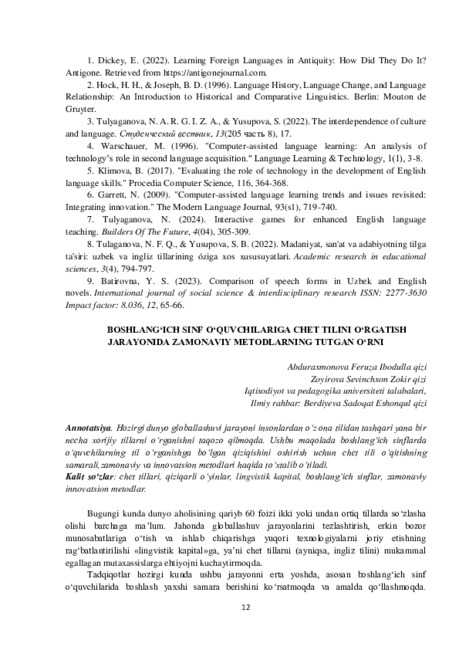
Boshlang‘ich sinf o‘quvchilariga chet tilini o‘rgatish jarayonida zamonaviy metodlarning tutgan o‘rni

Лингводидактические стратегии формирования второго языка у дошкольников
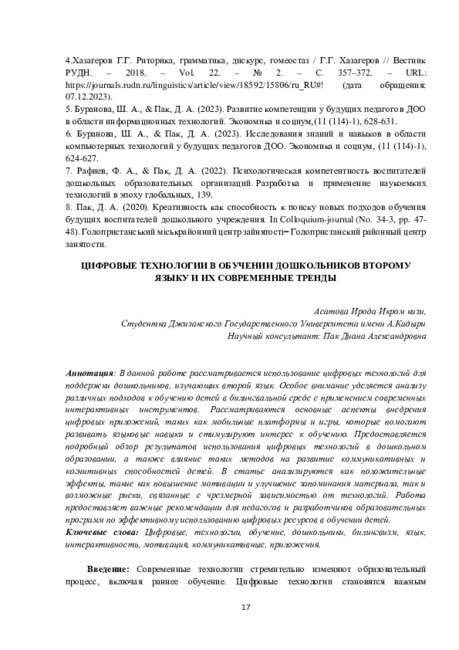
Цифровые технологии в обучении дошкольников второму языку и их современные тренды

The literature-based approach to enhance EFL students' reading and writing skills

Neuro-pedagogical methodologies: shaping cognitive skills in schoolchildren

The role of motivation in teaching writing

Yosh avlodga ingliz tilini o’rgatishda madaniyatlararo muloqot masalalarining o’rni va ahamiyati
Ma’lumki, madaniyatlararo muloqot - bu turli madaniyatlar va ijtimoiy guruhlar o'rtasida ma'lumot almashishga qaratilgan muloqot shakli hisoblanadi. Shuningdek, maqolada til va madaniyat о ’rtasidagi bog’liqlikni ilmiyjihatdan tahlil qilishgayondoshilgan.

Игровая методика как эффективный инструмент обучения дошкольников русскому как второму языку

Innovative approaches to teaching english as a foreign language

Лингвистические технологии в дошкольном обучении

Lexical expression of negation in the english language

Innovations in modern linguistics and language teaching

Имена прилагательные в романе М.Ю. Лермонтова «Герой нашего времени»

The concept of reading skills in primary school children

The effect of artificial intelligence systems such as ChatGPT on english language and translation processes
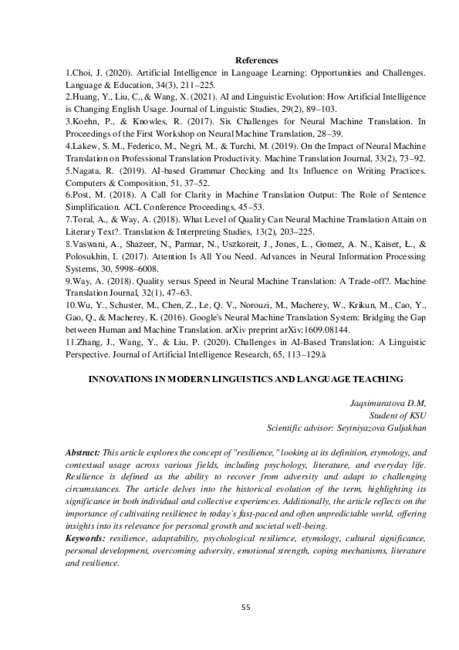
Innovations in modern linguistics and language teaching

Improving speaking skills through podcasts

Assessment of learning in language education

Мультидисциплинарные методы на уроках русского языка при формировании когнитивные универсальные учебные действия
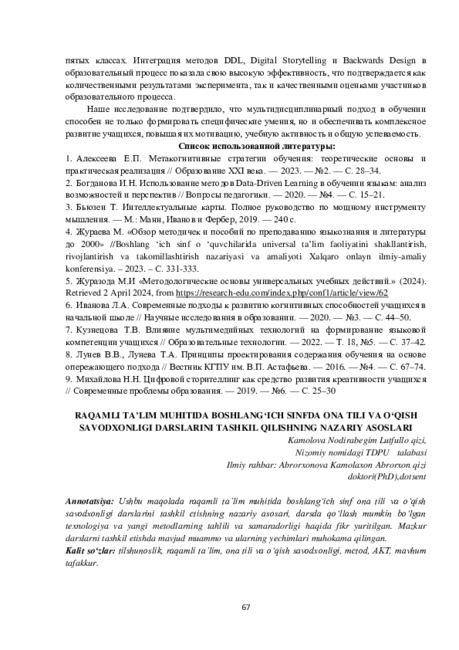
Raqamli ta’lim muhitida boshlang‘ich sinfda ona tili va o‘qish savodxonligi darslarini tashkil qilishning nazariy asoslari

The impact of adjectives on meaning and interpretation
Ixtisoslashtirilgan maktablarda kreativ muhit yaratishning metodik asoslari

Acting it out: the power of implementing drama and role-playing activities in language teaching

Emotsional intellekt va sun’iy intellekt: ta’lim jarayonida integratsiya

Methods of teaching writing skill to students

Ingliz tilini o'rganishning samarali yo’llari va foydali jihatlari

Proverbs: linguistic and cultural analysis

Ways of learning languages by using ICT and peculiarities in improving the competence of pedagogies

Challenges and opportunities in online language learning platforms

Современные технологии формирования англоязычной компетенции у детей дошкольного возраста

Using modern pedagogical and innovative technologies in teaching foreign language in higher education

Yangi innovatsiyalarining bog‘chadagi bolalarda kommunikativ ko‘nikmalarini shakllantirishda foydalanish

Maktabgacha yoshdagi bolalarning muloqot ko’nikmasini shakillantirishda yangi innovatsiyalardan foydalanish

Language levels in teaching foreign languages: phonetics, morphology and syntax

Constructive feedback as a motivation in teaching writing

Multimodal communication in the digital age

Инновации в преподавании русского языка:новые подходы и технологии
Введение инновационных методов и технологий в преподавании русского языка стало необходимостью, чтобы адаптировать обучение к требованиям времени и интересам студентов. Цель настоящей статьи - рассмотреть современные тенденции, методики и технологии, применяемые в обучении русскому языку, а также выявить проблемы, с которыми сталкиваются преподаватели в этом процессе.

Some effective methods for improving writing skills of learners

Sun'iy intellekt asosida til o‘rgatish tizimlari

Innovations in modern linguistics and language teaching

Роль сопоставительной грамматики в развитии речи студентов национальных групп

Maktabgacha ta’lim rahbarining professional imidjini shakillantirish

The language contact and multilingualism

Психолингвистические аспекты влияния языка на когнитивное восприятие реальности
Cognitive load theory and its application for learning

Metaforalar va ularning badiiy matnlardagi roli
O‘zbek maqollarining etnolingvistik tadqiqi (dehqonchilik asboblari nomlari asosida)

Zamonaviy ingliz adabiyotida mifologik obrazlarning mifologizatsiyasi va ularning o‘ziga xosligi

Teaching english to young children: gamification in early language learning

Efemizm termininiń úyreniliw táriyxi

The comparison of sentence structure in english and german languages

Comparative analysis of grammatical systems of adjectives in the english and karakalpak languages
The article presents a comparative analysis of the grammatical systems of adjectives in English and Karakalpak, focusing on their structure, morphology, and syntactic functions. The study aims to identify similarities and differences in the use of adjectives in these two languages, which belong to different language families (Indo-European and Turkic), and to determine how these features influence grammatical organization. The research employs methods of comparative typological analysis and descriptive grammar. Key aspects of adjective morphology are examined, including word formation, degrees of comparison, and the use of affixes. In English, adjectives form degrees of comparison synthetically (using suffixes -er, -est> or analytically (using more, most/ while in Karakalpak, suffixes (-рак/-реқ) and analytical constructions (ец + adjective) are used. Special attention is given to the morphological regularity of Karakalpak adjectives compared to the irregular forms in English (e.g., good/better/best/ The syntactic analysis focuses on the position of adjectives in sentences and their functions. In both languages, adjectives typically precede nouns, but Karakalpak shows greater flexibility in their placement. Differences in the use of adjectives as predicates and attributes are also explored. Contextual analysis and transformational testing methods are used to examine syntactic functions. The results demonstrate that, despite differences in grammatical organization, adjectives in both languages play a crucial role in describing the attributes of objects and phenomena. The study is of interest to linguists specializing in language typology, as well as to educators and students of English and Karakalpak.

Understanding karakalpak proverbs and sayings

The heritage of the steppe: karakalpak children's folklore

Tolerance: a fundamental principle for social harmony and progress

Innovative approaches to teaching english as a foreign language

Proverb as a genre of folk art

Rus paremiologiyalíq izertlewleri haqqínda qísqasha

Koreys tilida sinonimik xususiyatga ega murakkab fe'llar

Роль прагматики в лингвистике

Globalization and its impact on language policies and education

The use of artistic devices in karakalpak folk songs
Qaraqalpaq xalíq qosíqlarínda kórkemlew qurallaríníń qollanílíwí
The different varieties of english accent

Краткий обзор исследования лексики тюркского происхождения
Морфологическая вариативность в русских диалектах и социальных вариантах языка

English limericks as unique type of poetry

Тилшуносликда “термин, терминология ва терминологик майдон” тушунчаларига турлича ёндашувлар

Отголоски юности: образы, темы и философия песни Yuanzhou's youth от neo hou

Obyektda mehnat sharoitini o`rganish, jarohatlanish tahlili va uning bashorati, oldini olish tadbirlari

Die prozesse der derivation in der deutschen sprachwissenschaft

Значение русского языка как языка межнационального общения в Республике Узбекистан

Эмоциональный интеллект в языке: как русские речевые конструкции выражают эмоции по сравнению с другими языками

Dominant and endangered languages: the future of world languages

The voice of Karakalpak poets: a bridge between tradition and modernity

The nolinguistic study of Uzbek proverbs (based on the names of outerwear and their parts)

Methods and techniques for developing english oral speech at national groups of lyceums

Specific features of proverbs reflected national mentality

The peculiarities of word formation in English and Uzbek

Arab va O‘zbek tillaridagi kelishiklarning qiyosiy tahlili

Arab va O‘zbek tillarida rang-tus leksemalarining lingvomadaniy tadqiqi

The advantages of multilingualism in learning additional languages

Ethnolinguistic study of Uzbek proverbs (based on the names of footwear and their parts)

Cognitive approaches in modern linguistics and their application in education

How english drives the creation of new words worldwide
Ultimately, this analysis underscores how English serves not only as a language of communication but also as a tool for linguistic and cultural exchange, driving the creation of new words and expressions that reflect the dynamic, ever-changing nature of global societies.

Сравнительный анализ традиционной и современной грамматической парадигмы

On the grammatical compensation in the translation of national color in the works of I. Yusupov

Ethnolinguistic study of uzbek proverbs (an emphasis on hat terminology)

Парадигмы современной лингвистики в глобализированном мире и их влияние на развитие русского языка и литературы
Ekologik terminlarning struktur tarkibi

Понятие изоморфизма в лингвистической типологии

Лингвистические и когнитивные особенности английских предлогов

Neologisms in modern english: the impact of social media and digital culture

To‘lepbergen qaipbergenov qissalarida badiiy obrazlar yaratilishi

Til birliklariga kognitiv yondashuv

Zamonaviy tilshunoslik va ta'limda innovatsiyalar

The impact of social media on language simplification

Globаlizаtsiyаlаshgаn zаmonаviy tilshunoslik pаrаdigmаlаri
Sanlíqlardíń semantikalíq klassifikaciyasí (inglis hám qaraqalpaq tilleri mısalında)

Инглис ҳәм қарақалпақ тиллеринде санақ санлықлардың салыстырмалы изертлениўи

The role of emotions in language and communication

Qaratpa aǵzalardiń stillik qollaniliw ózgeshelikleri


